Hiển thị các bài đăng có nhãn roger corman. Hiển thị tất cả bài đăng

Thứ Hai, 10 tháng 8, 2015

BLOCKBUSTER HISTORY: THE FIRST FAMILY OF MARVEL

Every week this summer, we'll be taking an historical tour of the Hollywood blockbuster by examining an older film that is in some way a spiritual precursor to one of the weekend's wide releases. This week: once again, it has proven impossible to make a remotely decent movie out of the seminal comic book Fantastic Four. Let us travel back in time to the movie that, against all odds, is still the best attempt that anybody has yet made.

This is a story wherein, if you're the sort who'd interested, you already know everything I'm about to say. But please bear with me anyway, because the backstory is the heart and soul of understanding how things could have ended the way they did. Once upon a time, the idea of making movies based on Marvel comic books was at best a pathetic joke, and because of this, German producer Bernd Eichinger was able to snag the rights to the oldest of all Marvel titles, Fantastic Four, for a mere pittance in 1986. This was after one studio, Universal, had already sat on the option long enough for it to run out, and Eichinger would do no such thing: he actively pursued big studios to partner with his Neue Constantin Film to make a Fantastic Four movie that all would be proud of, or at least profit from. But in those days, there had only ever been successful feature films made with Superman and Batman, and they were much too fussy and costly for anybody to roll the dice on such an uncertain project as a superhero movie.

As the deadline on Eichinger's option, 31 December, 1992, approached, he finally concluded that since no proper movie would be made, at least he could make an improper one, and thus retain his option for several more years. Wisely, he teamed up with Roger Corman, film history's greatest artist at stretching a budget to the breaking point and then beyond, to help produce his minimum opus, which went into production on 28 December. Their target was a release date in fall 1993, eventually bumped to January, 1994, but before that could happen, forward-thinking Marvel executive Avi Arad found out about the project, and rather than allow the release of such a tiny piece of shit dilute the brand name of one of his company's toniest titles, he bought out Eichinger and Corman, essentially paying them more than the production cost of their movie not to release it. The option remained, though, and some 22 years after all of this happened, any new Fantastic Four movie is still a co-production with Constantin Film.

And so that explains why the officially-unreleased The Fantastic Four, the story of a man who can turn into a fireball, a translucent woman, a man made out of a pile of rocks, and a man with long-stretching elastic limbs would have such an enormously insufficient budget as $1 million, and why it is now only possible to watch it in the form of bootlegs copied from a single full-frame VHS tape that leaked somehow. That does not explain why, for all of its flaws, those forced by its outrageous poverty and those which were simple the result of sloppy B-filmmaking, it's still the best Fantastic Four feature in existence. But it certainly is, and by my lights, it's no particularly close battle. It's insane to use the phrase "good faith" to describe any aspect of this particularly cynical production, but I truly do suppose that the filmmakers put in a good-faith effort to make the strongest and most respectful adaptation of the comic book that $1 million could buy in 1993. Whereas none of the big-budget films attempted since then have had much in the way of respect for the material, or even basic human decency.

The poor bastards tasked with turning this business proposition into a movie were writers Craig J. Nevius and Kevin Rock, and director Oley Sassone; between them, Sassone's work on the Don "The Dragon" Wilson picture Bloodfist III is the closest anybody comes to an earlier film credit that suggests that they even actually exist. What they turned out is about as thoroughly generic as an origin story gets; in college, Reed Richards (Alex Hyde-White) and Victor Von Doom (Joseph Culp) were best buddies, and they decided to perform an experiment tied to the closest approach of a comet-like energy object called Colossus, which goes badly awry, killing Victor. Or does it? Of course not, but Reed won't find that out for ten years. During that time, he and his other best buddy Ben Grimm (Michael Bailey Smith) work on perfecting that experiment so they can execute it again when Colossus returns, this time without killing anybody. This involves flying Reed's experimental spacecraft right up next to the object; for reasons that honestly seem to be solely sentimental, they're bringing with them the now-adult children of Reed's college landlady, siblings Sue (Rebecca Staab) and Johnny Storm (Jay Underwood), and for a totally unnecessary dose of creepiness, it's clear that A) Sue joins the mission because she's been harboring a desire to jump Reed's bones ever since she was a child and he was a college student, and B) he's happy to have her join because he's now harboring the same desire, though thankfully it seems unlikely that he's been doing so for the intervening decade.

Things go amiss, they all get blasted with cosmic radiation, and they crash back on Earth with a new array of superpowers: Reed can stretch, Johnny can flame, Sue can disappear, Ben is a big strong rock dude (and is now played by Carl Ciarfalio in a suit). This is iconic stuff, Comic Books 101, I don't need to belabor it. Bitter that his condition alone can't be turned on and off, Ben leaves, and encounters the weird subterranean Jeweler (Ian Trigger), who has stolen a large gemstone vital to harnessing the power of Colossus, as well as kidnapping Alicia Masters (Kat Green), a blind sculptor, to be his bride. And Victor, now styling himself Dr. Doom and wearing a metal face mask to hide his scars, has popped back up trying to build a weapon using Colossus, and the four heroes must learn to channel their abilities to stop both villains.

All of that is messier when you're actually watching it, with the subplot around the Jeweler in particular feeling like it could have benefited from another draft or two. And, frankly, it could have benefited even more from having a more clearly defined villain than this original creation (there's no readily apparent reason not to have used the Mole Man, the very first bad guy in the Fantastic Four comics, who would have required only a little tweaking to the script). But for the most part, this is boilerplate superhero origin story shenanigans, albeit from a time when there were just a few superhero origin stories that had been filmed. The details, though, are anything but boilerplate: the stupefyingly low budget and fast-paced production schedule gives The Fantastic Four a boldly amateur charm, like watching a middle school play with infinite ambition to go with its near-complete lack of resources. The one place, surprisingly, that the low-scale production doesn't betray itself is in the costume used to turn Ben Grimm into the Thing: it doesn't really resemble a man of rocks very much (he looks like a '70s linoleum pattern come to life), but the mechanics of the face are surprisingly functional in the mouth and eyebrows, and Ciarfalio's physical performance is the best in the movie, making the suit itself seem flexible and organic.

The rest of the effects are, unsurprisingly, quite dreadful, with the Human Torch realised primarily through judicious cutting and Mr. Fantastic's stretching arms a comically awful rubber prop (transforming Sue Storm into the Invisible Woman is pretty straightforward, using techniques pioneered in the 1900s, but it's also totally unimaginative). And the costumes, sets, and makeup (the garish white patches of hair designed to make Hyde-White look old are especially unpersuasive) are plainly not up to the demands of a broad-scale superhero movie, looking like a bunch of Midwestern ladies whipped them up over the weekend.

Where the cheapness shines, though, is in the unmodulated, one-take performances, ranging from the professor (George Gaynes) in the first scenes whose enunciation is delightfully stiff and formal (pronouncing "radioactive" as two discrete words is my favorite), to the '50s sitcom bigness of the doctor (Robert Beuth) who overreacts to the team's curious physical conditions, to the leads themselves. Hyde-White is generically unctuous, and Smith is actually good, insofar as the role gives him anything to be good with. But the other leads are all over the map, with Underwood screaming like a tweaked-out junkie and Culp hamming and camping it up like Dr. Evil from the Austin Powers films, only done deadly straight. The sheer ebullience of the performances is totally unacceptable, but so joyfully bad and low-rent that it gives the film a genuine personality as the kind of bad movie that everybody involved plunged right into rather than felt their way through cautiously. And that is the best kind of bad movie. It's hokey as all hell, the final act is made of pure idiocy (culminating with the Human Torch, in the form of ghastly CGI, outraces a laser beam) reliant on clichés every step of the way, and there's simply no way for the action to look like anything but people bumbling about in underlit sets, but through all of this, The Fantastic Four is surprisingly cheery and committed to the cheap world it barely builds. And this is better than can be said for any of the subsequent attempts at doing the same material on a halfway-decent scale.

Thứ Tư, 17 tháng 6, 2015

SUMMER OF BLOOD: SCI-FI HORROR - A BAD CASE OF CRABS

In looking at the vast corpus of American movies made between 1945 and 1968 that are typically considered under the umbrella of horror, one thing that leaps to mind is that, almost without exception, they aren't scary. Nor, in a great many cases, does it seem like trying to make them scary was ever the goal. The definition of "horror" is and ought to be broader than just "scary movie", which is why the goofy dipshittery that makes up almost all of American cinema's genre work during the Atomic Age still counts. Still, it's easy to be endlessly frustrated by dumbass giant beasties and unconvincing make-up jobs and the whole nine yards, and wish that any of it was tense enough that a viewer over the age of 9 or 10 might genuinely find it terrifying, or at least creepy, or at least unsettling.

Enter Attack of the Crab Monsters, a 1957 ditty directed and produced by Roger Corman Allied Artists, from a script he extracted from one of his all-time greatest collaborators, Charles B. Griffith (the legend goes that Corman gave him a title and the directive that every scene should include action, without any of the pauses or layovers responsible for so many itchy asses in so many B-movie audiences, and Griffith came up with all the rest). This was at the very dawn of Corman's career: he'd only been producing for three years and directing for two, and this was just his eleventh feature as director. Because you know what Roger Corman did not do? He did not fuck around. And that applies to his movies as much as to his moviemaking: Attack of the Crab Monsters doesn't meet that platonic ideal of having absolutely no down time, but it gets right to business and it doesn't really waste any more time than it has to in plowing through its brief little running time, hardly more than an hour.

What I'm about to say next will sound stupid, and it is stupid, really. But here it goes: Attack of the Crab Monsters is that one shining exception to the rule I started off with. Look, it has that title, and it has that title for precisely the reason you might guess: there are giant, intelligent, mutant crabs, and they kill people. When we see them, which Corman endeavors to make sure doesn't happen too often or for too long, they look like hell. The characters being hunted by these freaks of nature are serviceable stock types played with a bare minimum of competence, and really not even that in the case of anybody with a strong accent. The shift from the second to the third act is carried on the shoulders of a tower of technobabble so confidently expressed by the script - and delivered by a dude with a fake German accent, to make it even more sciencey - that you can almost fail to notice what staggering, incoherent nonsense it is. And yet, when we know what those crabs are up to, the film manages to become honest-to-God unsettling. On top of the taboo-busting gore scene in the movie, that's enough to make this the one and only micro-budget independent trashy B-horror movie of its generation that I would actually be tempted to claim still sort of works, here in the 21st Century, as horror.

That being said, it still works better as a hilariously chintzy piece of fearless low-grade bad filmmaking. There is, for one thing, that most parsimonious of opening gambits, the stock footage montage - following the surprisingly lovely, hand-painted backdrops for the opening credits, it's ever bit of four minutes before we see anything that was actually shot for Attack of the Crab Monsters. First, we get a luxurious, unhurried array of atomic explosions, then we get a series of effects shots of a boat being swamped that, I suppose may have been original to this movie, but I'd like to think more highly of Corman than that. There's also a portentous Bible quote that makes no sense given the rest of the movie's content, but it involves killing things with water, so it makes sense as far as that goes.

With all that out of the way, we get to meet our team. Six specialists have been sent to a Pacific atoll: the leader is Dr. Karl Weigand (Leslie Bradley), a nuclear physicist, and along with him are geologist James Carson (Richard Cutting), botanist Jules Deveroux (Mel Welles, who never met an ethnic accent he couldn't chomp onto like a pit bull attacking a soup bone), radio man Hank Chapman (Russell Johnson), and a pair of biologists in love, Dale Drewer (Richard Garland) and Martha "Marty" Hunter (Pamela Duncan), because nobody would take a lady scientist seriously if she didn't have a boy's name, duh. They've been assigned two missions: one is to see what has happened to the flora, fauna, and structure of the atoll as a result of radioactive fall-out, and the other is to investigate the disappearance of the last team assigned for the first mission.

Things start going awry almost immediately: the Navy team assigned to protect the scientists suffers a gruesome casualty when Seaman Tate (none other than Charles B. Griffith) falls halfway out of the boat and thrashes around until his crewmates are able to pull him up, and find that his god damned head has been bitten off. We've seen so much more graphic and explicit things than that in the intervening half-century, but when you're watching a black-and-white movie made in this style, you expect a certain level of breezy frivolity: seeing a man's god damned head get bitten off remains just as much of a violation of the unspoken contract between the audience and the movie now as it would have in '57, and it's the first point where the viewer perks up to realise that this is going to be somewhat different than we were led to expect.

Meanwhile, the island is shaking violently at irregular moments, and when a portion of the naval mission prepares to leave, their seaplane explodes without warning. And the discovery of the previous mission's journals indicates that their disappearance had far more violent causes than the "lost in a typhoon" theory the Navy is forwarding. Something is clearly Mysterious and Dangerous on this island, and that's before the echoing, disembodied voice of the previous mission's commander starts drifting across the island at night. As the scientists, radioman, and two remaining seamen (Beach Dickerson and Tony Miller) start investigating, they're taken down at a feverish pace, by an unseen thing with barely glimpsed crablike parts (it's hard to say whether Corman was trying to create a sense of mystery - not a winning strategy in a film with "Crab Monsters" in its title - or simply avoiding showing more of the crabs than he had to), and everybody who vanishes comes back the same night in the form of another echoing voice.

Between the no-nonsense script and the even more no-nonsense direction, Attack of the Crab Monsters blazes by so quickly that its basically a whirlwind of shocking deaths, later to include a dismemberment that makes the first decapitation seem utterly banal. It's a terrific gambit, not least because it prevents us from lingering over the film in a way that reveals its shortcomings, which include at a minimum the snoozy characterisations - Marty is at the center of a romantic triangle that totally refuses to land - and the fact that the film has the indication of a story more than the actual details and fullness that really are a story. Or how much the setting does not resemble a Pacific atoll beyond the presence of an ocean.

Also, the film's pace serves a more abstract function: it keeps us out of balance, and makes us more susceptible to the eeriness inherent in the film's best element, those disembodied voices. It's a cheap trick (they're all cheap tricks), but just modifying the sound to give it a hollow, metallic edge makes those voices feel truly wrong on an instinctual level, even before we learn exactly what's causing them. The reveal of that is another one of the film's most unsettling elements, though it takes some wading through the worst of the pseudoscience to get there - the crabs, who have been nuked not just into gigantic size, but also into a quantum state where they are made of pure energy, or whatever it's supposed to be, can absorb a person's identity by eating their head. It is so dumb as the defy believe, but there's also something skin-crawling about the matter-of-fact way the film drops it in, a form of body horror before there was body horror. "Once they were men; now they're land crabs" is a loopy bit of dialogue, but it speaks to a sick notion, much bleaker than the average for a giant nuclear monster picture. Especially as Griffith lays the groundwork by referencing the real-life tendency of land crabs to devour wounded humans left unattended on the beach.

The film foregrounds none of this: it's all buried beneath some delightfully campy idiocy typical of the genre, with that extra spin of dazzling showmanship that separated Corman from all of his peers. He wasn't all the way there, yet, except in his wisdom in showing just enough of just the right parts of the crabs - when he can't keep hiding, and we can see their big cow eyes, it's all over but the laughing. It's a sturdy piece of B-movie filmmaking with a crowd-pleasing energy that's much more enjoyable than most other films on this model. It's a terrible, terrible movie - any film that gives its giant crab monster a threatening climactic line like "So, you have wounded me, and I must grow a new claw. Well and good, for I can do it in a day. But will you grow new lives when I have taken yours from you?" isn't ever going to be anything but terrible. But it is the zesty, vital kind of terrible, and this most dodgy and dimwitted of all subgenres was rarely more fun in its all-encompassing badness, or more effective in mining something memorable out of its stock elements.

Body Count: 9, though it is at least possible that we didn't see everybody who was on that seaplane.

Thứ Năm, 7 tháng 8, 2014

HOLLYWOOD CENTURY, 1966: In which we briefly turn our gaze to the Los Angeles-based independent scene, and their ability to adjust far faster than the studio system ever could

My first thought is not a very professional one: holy shit, Diane Ladd used to look exactly like her daughter. Now that I've got that out of my system, I can turn to the matter at hand.

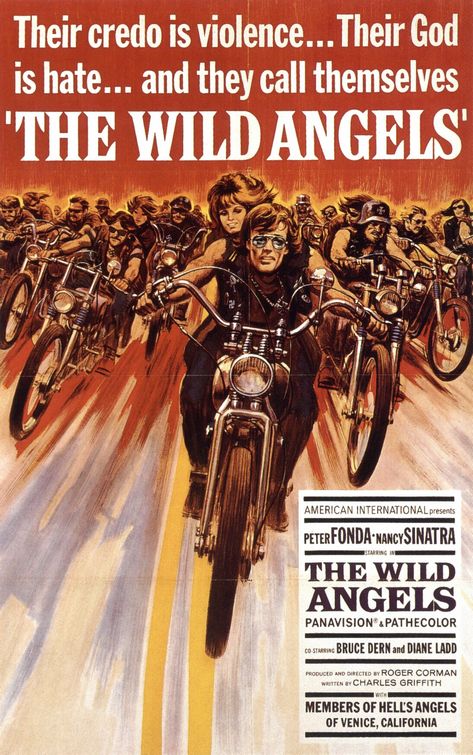
And the matter at hand is The Wild Angels, a film without which the subsequent history of cinema would look wildly different. This was the movie that really kicked off the biker film fad of the middle and late 1960s, not because it was first (biker pictures had been around for over a decade, though their popularity, and the popularity of the juvenile delinquent film more generally, began waning towards the end f the '50s; nor was it the first biker movie of the mid-'60s), but because it was by far the most popular, coming out at the exact moment when the rising notoriety of the Hell's Angels brought the subculture back into the limelight and made the time perfect for a savvy producer to exploit that culture for all it was worth (not incidentally, Hunter S. Thompson's Hell's Angels came out around the same time as the film). And oh, how The Wild Angels had a savvy producer, the savviest of them all: Roger Corman, who also directed, making the film under the aegis of American International Pictures, the most savvy of all bloodlessly mercenary independent film companies.

Anyway, that's not the reason the film had such massive influence, though it's a little bit interesting. The really important thing is that Corman had the good sense to cast in the film's lead role Peter Fonda, an unusually prominent figure in the burgeoning counterculture, owing to his rock-solid establishment bona fides (being the son of Henry Fonda would do that), mixed with his rather showy rejection of that establishment and his retrenchment within the West Coast hippie scene. This gave The Wild Angels an immediate shot of verisimilitude, and even more importantly, it got Fonda to thinking about deeper themes that could be explored using the mechanism of a biker film, and after a couple of years, that development of his onscreen persona and his offscreen philosophy, as initiated by this film, resulted in Easy Rider. And that film's seismic place in the development of American film is both well-known and undeniable.

The Wild Angels has to settle for being a pretty satisfying bit of grimy exploitation, not a cultural flashpoint and medium-altering achievement. And I suppose that's just the way Corman would have wanted it, him being one of cinema's all-time great pragmatists: I do not suppose that anyone would genuinely accuse him of having one-of-a-kind skills with the camera or actors, nor did he ever make a film that fundamentally challenged the way that stories could be communicated visually. But at his height, he was a genius anyway: rare indeed was the filmmaker who could so accurately predict what the audience would want, and when they'd want it, and then make a movie to fulfill that want for a budget that's closer to the cost of a new car than a "real" film production.

Clearly, The Wild Angels scratched some itch for watching the exotic, brutal adventures of barely-disguised Hell's Angels analogues (indeed "barely disguised" is giving the film the benefit of the doubt: the motorcycle club is named specifically in dialogue, and while we never see the Angels' famous death's head logo, the jackets the bikers wear are otherwise dead ringers for the famous, infamous Angel colors). Movies don't create genres without tapping into some deep-seated cultural current. And yet, the most conspicuous reality of The Wild Angels is that it was plainly made by old men who had no real idea about the subculture they were depicting. Corman himself was the very model of a square, far more concerned with how to squeeze every penny out of his projects, and when sociological messages crept into the films he wrote and produced, it seems to be mostly because he didn't see any profit in preventing his screenwriters from squirreling some themes away into the subtext. And he commissioned the script for the film from his good lackey Charles B. Griffith, who was, confessedly, one of the people who threaded some interesting subtexts into his scripts, but certainly couldn't count himself part of the counterculture. Much of the screenplay was rewritten by Peter Bogdanovich, who at least comes closer; but he was more of a film nerd than just about anyone else in a generation of film nerds. And from the onscreen evidence, in which authentic-sounding biker slang is wielded in the most stiff, inorganic way possible, we can go on and assume that nobody involved in putting that screenplay together was practicing anything like embedded journalism in making it happen.

The result - this is the key part - is that The Wild Angels falls into a foggy place where it at once wants to serve as a niche-targeting movie for all the young people beginning to voice the same sentiments about freedom and a lack of responsibility that we hear spoken by the characters onscreen, while pathologising that attitude as proof of the essential hedonist immorality of the characters espousing it. Basically, it's a piece of bikesploitation that deeply fears the dangerous potential of bikers and biker culture, but carries itself like a rabble-rousing cry of passion, in total sympathy with its characters, getting just at outraged at the injustices carried out against them as they are. It's a fucking weird mix of form and message, and I suspect that in the cold light of day, it means that The Wild Angels is an incoherent piece of nonsense; but since I am a Corman booster in good standing, I choose instead to take it as proof of his canny ability to make everyone happy at once. And since the film ended up a hit among the proverbial Kids These Days, he must have done a good job of it.

The Wild Angels is an early example of the "slice of life" picture, telling very little in the way of plot; it has an incident that shapes and guides the entirety of its hour and a half, but there's not nearly enough of that to make for a proper drama, and mostly what we see are people existing, responding to that incident but not with a great deal or urgency or, apparently, sense of things being terribly unique. And this too is part of the Corman school of stretching a buck: show as much talking as possible, at the expense of action, and if the talk is colorful and descriptive enough, nobody is going to very much care. The deal, basically, is that club leader Heavenly Blues (Fonda) has picked up some news that the missing bike belonging to his follower, the Loser (Bruce Dern) has been spotted in Mecca, Mexico. So the Angels say goodbye to their old ladies - Blues with his girlfriend Mike (Nancy Sinatra), Loser to his wife Gaysh (Ladd) - and discover that the bike has been stripped in a chop shop. In the ensuing brawl, the Loser snags a police bike, and a chase follows, leaving him shot, while the rest of the Angels escape. Sensing a trap, Blues nevertheless okays a mission to steal Loser from the hospital, and while they are successful, a nurse that some of the Angels tried to rape - Blues stopping them - identifies them. While the Angels head into Northern California to stage a funeral for their fallen comrade, the police begin to plot their capture of the notorious bikers.

Put it like that, and it sounds action-packed, but in the laconic, character-driven way it unfolds, it barely registers that there's any continuity between scenes at all. It's very existential in its feeling, in fact, certainly pushed in that direction by Fonda's restrained, uninflected performance. By the time the last scene rolls around, with Blues rather despondently giving up all hope - a precursor to the "We blew it" moment from Easy Rider, though played with more dramatic nihilism here than there - the film has been so fully saturated with an elegaic tone thanks to Fonda's work that even when it's at its most alarmed (such as in the borderline campy funeral scene with the Angels profane a church), the film feels more tender and sad than outrageous and exploitative.

But exploitative it is, and alarmist: from the opening credits, in which the "W" in "Wild" is cross-bred with a swastika, the film's insistent comparison of the Angels with brutality, anti-social behavior, and Nazi imagery is pervasive, and at weird odds to its emotional investment in their attempt to find peace, however they define it. I really can't explain it other than to assume that Corman and AIP were openly anxious to get both the bikers and the moralists on their side; that, or they only cared about being salacious and edgy, without reference to anything deeper than "what sells?" At any rate, I have no idea if the film's depiction biker culture is remotely accurate, either in its attempts at realism or its attempts at scare mongering; I just know that it's a weirdly moody, frequently dysfunctional drama whose completely casual depiction of the California underclasses has a raw, realistic tang that studio pictures had an immensely hard time matching, slow as they were to respond to the shifts in culture. And it is never less than fascinating, even when it's clearly not working on any level.

Also, it has a scene where Fonda, disgusted with himself, his lifestyle, the society that wants to tame him and his people, the planet that bore them all, stands alone outside at night, while yowling cats have been foleyed onto the soundtrack so loudly and aggressively - and a whole bunch of different cats, too - that the movie suddenly feels like it's drifted into some kind of avant-garde Catwoman riff. I have no idea how it fits into the rest of the film on any level, but I adore it: it never hurts to forget that, for all their fascinations, the films of Corman and AIP, together and apart, are still basically terrible, and moments like that are glorious reminders of how goofy low-budget B-movies could be.

Elsewhere in American cinema in 1966
-The short Winnie the Pooh and the Honey Tree is the final animated film released by Disney before its namesake's death in December
-John Ford, a man's man of a director, ends his career with the decidedly uncharacteristic 7 Women
-Avant-garde artist and self-aware brand name Andy Warhol makes his mainstream breakthrough with Chelsea Girls

Elsewhere in world cinema in 1966
-Sembène Ousmane's Black Girl, a Senegalese-French co-production, brings sub-Saharan African cinema to international attention
-Italian master Michelangelo Antonioni makes the anti-thriller Blowup in England, documenting and autopsying the newly-forming counterculture
-The criminally under-appreciated and horrifyingly short-lived Soviet filmmaker Larisa Shepitko makes Wings, her first feature after graduating from film school

Chủ Nhật, 8 tháng 6, 2014

SUMMER OF BLOOD: NOVELTY MASSACRES

If it had done nothing else to distinguish itself, 1982's The Slumber Party Massacre would stand out in the crowded glut of early '80s slasher films by virtue of being written by a feminist. Not, please understand, the kind of everyday feminist that anybody could be who believes in equality between the sexes and calls out discrimination and anti-woman behavior when she sees it: an actual leading light of movement feminism, Rita Mae Brown, the lesbian activist and author of the pioneering novel Rubyfruit Jungle, a radical so devoted to her causes that she publicly sparred with Betty Friedan.

In other words, the last sort of person on Earth who you'd expect to have anything whatsoever to do with a genre that, from almost the first moments of its existence, was being identified (fairly, and often accurately) as being a hotbed of misogyny and the objectification of women, a narrative formula that offered a chance for nervous teenage boys to ogle naked girls and then watch them get sliced in half by sexually puritanical psychopaths, and sometimes very little else besides that.

The story behind this is among the best-known in slasherdom, but we'll run through it real fast anyway. Brown's original screenplay, titled Don't Open the Door, was a parody of the slash form, one that mocked exactly the things that a feminist activist author (or, y'know, a decent human being) would find most problematic about the subgenre: the unmotivated nudity, the violence against women, the phallocentrism of insane men stalking girls and penetrating them over and over again with their long knives, penetrating them to death. And I would be darned interested in seeing the movie she had in mind when she wrote that screenplay. But something happened to Don't Open the Door that Brown wasn't prepared for, which is that Roger Corman got his hands on it. And while Corman was a man who did much good for many independent filmmakers in the horror and thriller genres over the years, he had the soul of an exploitation huckster. There's little room for feminist satire in exploitation films, and Brown's vision was doomed from that moment. In the end, Corman received no official credit as producer, and the film was handed off to an editor in his sphere of influence, Amy Jones (now going professionally as Amy Holden Jones), who made her directorial debut with the film.

Pause for an anecdote: Jones cinched the job by cobbling together an eight-minute prologue to show to Corman. Just a quick and dirty bit of backstory that, as she's observed, looked better than the film itself, despite its on-the-fly nature, because the DP on the project was her husband, Michael Chapman. Which means that at one point in this world, there existed a sequence from a slasher movie shot by the cinematographer of Raging Bull right after he completed that project, and if that's not just the damnedest thing I ever heard. Unpause.

Perhaps owing to an innate lack of humor, and perhaps hoping to please the boss, Jones revised Brown's script to make it more of a straight slasher film and shot it without a trace of obvious comedy, irony, or satire. In fact, despite being helmed by a woman working from an explicitly feminist screenplay, The Slumber Party Massacre somehow manages to be one of the slimiest, trashiest slasher films of the subgenre's early period. It is male gazey in ways most films directed by males can't even manage: in a shower scene which the film lingers on and attends to with a stateliness and unhurried air that recalls the descriptions of battles in War and Peace, there's a shot that starts on a naked woman's soapy back, tracks straight down to look at her ass, looks at it for a few seconds, and tracks back up. If this is satire, it's on some unbelievably rarefied level that I am completely unable to comprehend; there's always the "parody through sheer exaggeration" argument, but that takes a fantastically deft hand, and Jones, who I reiterate was making her directorial debut on a film that had to make money for Roger Corman, does not have that hand. No, woman in the director's seat or not, this is just one big pervy adventure in objectifying the every-loving shit out of every female character the film can get its hands on. As it were.

At any rate, on the face of it, you couldn't ask for a more pure, direct, unimaginative slasher. In Venice, California, a high school basketball player named Trish (Michelle Michaels) is alone at home for the weekend, and she and her three teammates and BFFs have decided to have an old-school slumber party, just for the girls, to relive their glorious days of youth. Those friends include Kim (Debra De Liso) and Jackie (Andree Honore), distinguishable solely in their hair color and skin tone, and Diane (Gina Smika), the designated bitch. This first comes up in the locker room after practice, when Trish suggests inviting the new girl in school and on the team, her next-door neighbor Valerie (Robin Stille); the group consensus is to send the invite, but Diane so noisily complains about what a violation of their group dynamic that would be, with Valerie only about two feet away, that the new girl politely declines and runs home to be with her smutty-minded younger sister Courtney (Jennifer Meyers) all night. To spice things up, Diane's boyfriend John Minor (Jim Boyce), whom the other girls all dislike, is hoping to sneak over to the girls' night to make out and probably more; and a pair of boys, Neil (Joseph Alan Johnson) and Jeff (David Millbern), who are not distinguishable at all, have gotten wind of the party and decide to spend the night peeping in windows.

So that's the Expendable Meat, and the Horny Kids Who Will Die For Their Sexual Trangressions. While all of this has been brewing, we've also been introduced to our killer: Russ Thorn (Michael Villella), a psycho who went on a killing spree man years ago, and who's just escaped from prison. His first onscreen action is to ambush a telephone repairwoman (Jean Vargas) in her van, with a gigantic power drill; this gives him a spooky white vehicle to drive around and appear in the edges of shots, as he heads straight for the high school to gaze at the young women leaving. How he finds out about the slumber party, what his deal is anyway, and whether he has some eerie psychic connection to any of the girls is totally immaterial. He's a psycho killer, they're nubile young women with drugs and drink, and that's an attractive force stronger than gravity.

In 77 minutes that are brief even for junk food horror movies from the '80s, Thorn kills a startlingly large number of people with his massive tool, with Diane's death in particular (not a spoiler; the Designated Bitch never lives) finding Jones and cinematographer Stephen L. Posey consciously framing it as a rape and the drill as a metaphorical penis. And that's it as far as obvious traces of any kind of feminist reading on the slasher genre; there's also the bit where the drillpenis is castrated, but Jones underplays it severely. "Jones underplays it" is a useful phrase to hang onto while watching The Slumber Party Massacre: it's a film rife with things that, even if we don't know the film's history, feel like they're kind of supposed to be jokes, except that they're not playing that way. There's a repeated bit where Trish keeps not noticing news stories about Thorn's escape, and another, even more frequently repeated bit where men who are not the killer and have no apparent ill motives grab women by the throat from behind, and both of these seem kind of like running gags; but they're staged with exactly the same timing and framing as any tension-building beat from any slasher film. There's a defiantly odd scene where the somewhat creepy neighbor, Mr. Contant (Rigg Kennedy) - whose creepiness is not built up at all, not even where he basically tells a bunch of teenage girls that he won't tell on them for smoking pot if they don't mention that he was stalking around the house, wink wink - is out hunting snails at night with a meat cleaver, and that's not even good as comedy, though at least it's explicable. Here it's just treated as a generic false scare.

What we learn from The Slumber Party Massacre ends up having nothing to do with subverting male power, or giving women control, or challenging male gaze, or any goddamn thing at all, but this: when you make a parody and decide not to have any of the jokes be funny, you've basically just made a shitty version of the shitty thing you were parodying, and if there's a distinction between "this is very bad" and "this is an exaggerated version of a bad thing", it's wholly academic. This is a crappy film with bland performances - in a film crazily awash with gratuitous nudity, the actresses willing to show up would be from a rather shallower pool than even the normal slasher film could boast - and a brutally perfunctory plot that almost explicitly treats the undifferentiated characters as dominoes to be set up in the first 40 minutes, so that they can then be killed off at a pretty fucking steady clip. From the 45-minute mark until the film ends 32 minutes later, there's a death, on average, every 3.5 minutes, a pace that would make Jason Voorhees himself stand back impressed. And they are not very interesting deaths, either - one scene, the film's single good one, finds two of the girls unaware that Thorn is creeping in through the window behind him, and it's nicely tense, but the deaths themselves are mostly hidden behind quick cuts (naturally, the boys die in shock moments and the girls get stalked a bit first), and the stage blood looks positively chintzy.

And that's really the worst of it: it's not just bad at the level of storytelling and direction, it's genuinely poorly made. There's a scene early on where Michaels rushes a line and Smika fumbles her through dialogue that suddenly comes across as redundant, and they just left it right there in the damn movie. And the sound - Christ's love, the sound mixing! - if it's not the loudest curtains in the whole wide world being closed with a rustle that sounds like the house's foundation shattering, it's a moment between Trish and a lady carpenter (Pam Canzano) - the presence of multiple women in traditionally male jobs also being something that feels like it's not nearly as important as it could and should be - that includes an amazingly balanced line that goes something like "YOUR BOOKSHELVES WILL BE READY nexsht Tueshday".

It's so easy to see the film that The Slumber Party Massacre isn't quite - the absurdly overly emphatic, self-mocking, weird, and caustically satirical one that may or may not be what Brown had in mind, but would still qualify as a parody - and be angry at it for existing in this half-assed form, but I'll say this for it: it's distinctive as anything. The strain between content and tone leaves it feeling like no other slasher film of that period, and while it also leaves it more frustrating and ineffective and just plain crappy than the great majority of slashers... it stands out. In a subgenre as routine and formulaic as this one had already become by 1982, that counts for an awful lot.

Body Count: 12, not all of whom I actually got around to naming, because of the characters who show up for literally no narrative reason other than to die. Again, if there's a difference between exaggerating for effect and just being trashy, The Slumber Party Massacre does not know what it is.
Breasts: 8, by which I mean 8 distinct occurrences of breasts, not 8 breasts overall; it is in fact six pairs and two individually, some of which are duplicates.
Asses: 4 belonging to girls, 1 belonging to a man in a Playgirl spread.