Hiển thị các bài đăng có nhãn exploitation films. Hiển thị tất cả bài đăng

Chủ Nhật, 19 tháng 7, 2015

SUMMER OF BLOOD: THE SLASHER FILM - A REAL NAIL-BITER

So you'd have to be such an idiot that there's not a word for it in English to expect a film titled Nail Gun Massacre to be even a little bit classy. Still, the speed with which it reveals the incorrigible depths to which its not-classiness reveals itself caught me by surprise - it's not just any movie that opens with a gang rape, and by "opens with a gang rape", I don't mean that's what happens in the first scene. I mean that's what happens in the literal first second of the film's running time.

And with that jolly kick-off, I welcome you to the absolute dregs of human artistry: direct-to-video horror movies in the 1980s. The great slasher boom had largely exhausted itself by the end of 1984, just in time for the newly expanding home video market to create a new, if even cheaper and more threadbare opening for for savvy producers with a halfway decent make-up artist and a couple young actresses willing to take their tops off. It was a grubbier world with fewer rules and smaller budgets, attracting and thriving on a lower tier of talent than was necessary to pass theatrical muster. This resulted in some of the tackiest, tawdriest movies in the history of the medium as well as some of the most impossibly ill-made. Even within that company, though, Nail Gun Massacre is something special. There is not a more inappropriate word than "special". I'm sorry. That's just horrible writing.

But faced with the garishness of a movie depicting a rape in its opening frame, and only gets worse and more exploitative from there, language itself starts to break down a bit. You know that feeling when you're watching a movie for the first time, and you can already tells that it's one for the ages? Nail Gun Massacre is the opposite of that. In my notes I had written down "this is the fucking worst" before the 10-minute mark, and "this is THE FUCKING WORST MOVIE IN HISTORY" around an hour in. That's probably hyperbole. It is, however, the worst movie of the 1980s. I'm very comfortable and confident in making that claim, and I don't give a shit if I haven't seen every movie of the 1980s yet.

An attempt to describe in prose the experience of watching the film would be titanically boring, since there is virtually no plot, and the little bit that scrapes its way through, the film tries very, very hard to keep hidden. So it begins, a propos of nothing, with a gang rape, yes? And then people start dying? Unless this was to be some manner of confrontational, experimental anti-narrative, in which unrelated events take place in an arbitrary order, we can be forgiven for assuming that the murders are an act of vengeance for the rape. That's basic, 1+1=2 logic. Even the briefest, monosyllabic summary of Terry Lofton's heavily reduced script implies that motivation for this particular massacre. The movie pretends that we haven't figured that out for almost 70 minutes. This movie is a grand total of 85 minutes long. That's a repellent amount of stalling for a story that literally could not function without its "secret" being obvious from the opening, and the scene in which Doc (Rocky Patterson), the thirtysomething doctor in a small Texas town who is the closest the movie has to a hero, explains his realisation is static, maddeningly dull, and criminally mis-performed by Patterson, who like every member of the cast seems to be reciting lines that he can't begin to parse and never memorised. Elsewhere in the film, two men who were part of the original crime say their goodbyes to the visibly hostile owner of a lumberyard (Beau Leland), who mutters under his breath "I'll see you sooner than you think" with a snarl on his face. GEE I WONDER WHO THE KILLER MIGHT BE. And the film acts as though we didn't notice that, either.

There is one possibility I can imagine that might justify all this as anything but rank incompetence: co-directors Lofton and Bill Leslie were aware that the audience only cared about the killing scenes, and gave the plot away to let the audience stay ahead of the story and enjoy the ride, like Hitchcock and Vertigo. It's certainly the cast that Lofton and Leslie were only interested in staging murders; God knows there's little enough else that happens in the movie. I've already punted on trying to explain the story, but if I were going to, it would be something like this: men, usually two, who presumably had something to do with the rape - the movie doesn't try very hard to make sure we recognise characters from the opening scene, up to and including the victim, and the killer attacks plenty of people who had absolutely nothing to do with, including no fewer than five women, which I think spoils his feminist bona fides - are in an isolated location. They are approached, in a comically abrupt fashion, by a wiry little man in camouflage and a jet black motorcycle helmet with the eyepiece covered in gaffer tape, and with a ludicrous synthed-up voice that sounds like a cross between Darth Vader, Jeff Foxworthy, and Ben Stein. He quickly kills one of them with the nail gun he has handy, and then spouts several sentences. Some of them quips; fewer of them puns than you'd think. "You should never hitch a ride with a hearse, unless you're dying", he snaps to a hitchhiker to tried to thumb a ride, which is A) not funny and B) not wordplay. Oh, and the bit about the hearse is because the killer drives a hearse that has been painted bright gold. It says so much about Nail Gun Massacre that I almost forgot to mention a detail like that. He then kills the other person, if there were two, and quips some more.

As a palate cleanser in between these evocative scenes of people slumping to the ground with the heads of nails glued unpersuasive to their faces with red food dye being dribbled on their skin, we encounter Doc and the Sheriff (Ron Queen) executing the most aimless murder investigation in the annals of crime, which consists mostly of swapping the observations "[chaws thoughtfully] We nev'r used ta have this many killin's". "[nods, or just stares glassily for about ten seconds] Lot of 'um happening on Old Lady Bailey's property. Wonder if we should go to th' house". "Aww, you don't think Old Lady Bailey has anything to do-" "Course not".

Along the way, we're introduced to a panoply of non-actors of the most awe-inspiring sort. I'm particularly fond of the helpless soul who delivers the line, "Well Tom, in your infinite wisdom, I'm sure you will figure it out in due time" without seeming to know the meaning of any word in that sentence other than "Well" and "I'm". But the clear standouts are Frances Heard (Terry Lofton's grandma!) as a shopkeeper who keeps adjusting her glasses and fearlessly marches on through her pointless expository lines even after she fluffs some of them, and an old man whose identity I cannot certainly attest to (the credits are full of vague descriptions with #1 and #2 following almost all of them) who loudly mumbles with the most impenetrable Southern accent I've encountered in movies in a long while.

Not helping the actors at all, the scenes that don't involve people dying have a nasty tendency to stretch to several minutes a moment that could have been dealt with in half of a line, and frequently could have been snipped out of the film entirely. Such as the great "getting directions" scene, with the dialogue being largely drowned out by background traffic noise. But slamming the film for its technical limitations would be like kicking a beagle puppy. And insulting the directors for their lifeless camera would be pointless, almost as pointless as losing interest in the action altogether to blandly zoom into a naked pair of breasts.

Oh! That's another thing, the porn! Twice, the movie stops being an addled collection of shoddy death scenes and a glacial depiction of the minutiae of human conversation to watch people having simulated sex. And in real time. In fairness, assuming that the cast was hired because of their experience in regionally-produced rural Texas pornography answers most of my objections to the acting, but I don't think that's fair to assume. Anyway, the end of the first sex scene is my favorite part of the whole movie: the dude is lying there dead, and the woman falls on top of him, and the image simply refuses to move or cut for tens of seconds, all while the framing pretty much insists that we notice that their pubic hair is extremely visible in both cases.

This is the most bitterly functional kind of slasher movie that could possibly be: a weak pretext that's only followed about half of the time for a lengthy chain of killings with almost nothing else that could possibly constitute a narrative. It is vile, and it is sleazy, and it is insufferably slow moving nearly all of the time. There is one and only one saving grace to any of this: it is also indescribably ill-made. The acting, the writing, the staging - it's amateurs and first-timers, mixed with an awful degree of cynicism about the market sector the film is targeting. It is, frequently, truly impossible to believe that the thing onscreen could possibly have been made, and it's so daft that it manages to be weirdly compelling even though the whole thing is rotten, from the core to the surface. I have never seen such a reprehensible slasher movie in all my days, but that's not to say that it's not transfixing.

Body Count: 16, and impressively, only one of those does not involve a nail gun. Truth in advertising!

Chủ Nhật, 5 tháng 7, 2015

SUMMER OF BLOOD: HORROR GETS MEAN - MEET THE PARENTS

Any honest accounting of the history of American horror filmmaking has to bow in the direction of the enormous influence of The Last House on the Left, the 1972 debut of writer-director Wes Craven and a solid contender for the title of most controversial movie of the last half-century. It is a film that links elbows with the two-years-younger Texas Chainsaw Massacre to go skipping down a primrose path strewn with body parts and pooled intestines, as the two most viciously nihilistic movies of an entire generation, the two movies that most directly and punishingly place the national psychic trauma of the late years of the Vietnam War into cinematic language, in which violence is shown as a depravity that makes you feel worst about life and yourself for having watched it. In terms of the marketplace, it triggered an enormous wave of knock-offs, and it more or less invented the subgenre "watch as the plot stops so that something absurdly wretched can happen to basically decent people in stomach-churning explicit violence".

Nothing I could say could ever take away the seismic importance of Last House in the development of a newer, burlier, nastier mode of horror, and I wouldn't want to try. That said, alongside its absolute, quintessential status in the genre's history, the film has also generally accrued a reputation as a great horror classic, on top of its evolutionary importance. And that just baffles the ever-living hell out of me. As I watch The Last House on the Left, I don't merely see a film that fails to be as good as it ought to have been - for that, we had better look to its altogether superior 2009 remake - I see a film that's borderline incompetent in all the places that matter the most, constantly sabotaging itself and robbing all of the impact from the handful of scenes that are able to accrue some measure of power. It's amateur-hour indie junk, not to put too fine a point on it, and whatever it manages to achieve as a powerful indictment of the human capacity for hatred and violence is nothing next to its status as a long lost Keystone Kops feature cut together with the world's shittiest folk musical.

Like all of the most grueling exercises in grind house viciousness, The Last House on the Left started life as an Ingmar Bergman film. The film is an uncredited remake of 1960 Cannes competitor The Virgin Spring, in which a medieval Swedish Christian girl is raped and murdered in the woods, her parents accidentally meet her killers and then kill them, and to cut off the cycle of vengeance and violence, her father dedicates her resting place to God and prostrates himself, begging for forgiveness, while the family's pagan maid looks on in wonder. Transfer the setting to 1970s Connecticut, remove the spiritual overtones and burning need for expiation, and hit Sven Nykvist in the head with a baseball bat until he forgets how shoot a movie that doesn't look like somebody dried off their sweaty testicles with the camera negative, and voila! You have Craven's attempt to fuse exploitation and documentary in one intense package.

It's the day before Mari Collingwood's (Sandra Cassel) 17th birthday, and she's got a big night planned: she and her edgy friend Phyllis Stone (Lucy Grantham) are going into New York City to see the band Bloodlust. It's a typical piece of adolescent overcompensation, trying as hard as she possibly can to shock her well-off bourgeois parents Dr. John Collingwood (Richard Towers, appearing under the hilariously ultra-WASP name of "Gaylord St. James") and Estelle (Cynthia Carr), and they respond with exactly the ill-concealed dismay at their daughter's life choices that she was undoubtedly trying to kick up.

Already, by the film's three-minute mark, we've encountered two of the things that will primarily ruin The Last House on the Left: terrible filmmaking and terrible acting. The latter, at least, is explicable: the film was conceived by Craven and producer Sean S. Cunningham (who would, eight years later, drop another bomb on the horror landscape when he produced and directed Friday the 13th) as an actual hardcore sexploitation film, deciding only at the very start of shooting that it would be better for their artistic aspirations (which were "indict a culture of violence and rape", not "get main in raincoats to whack off to a rape scene") if they dropped that angle. But they'd already assembled a cast entirely out of pornography veterans. And even though pornography in the early '70s was at its all-time height of sophistication and cultural acceptance, it wasn't a Petri dish of high-end acting talent. That being said, just because we can rationalise on paper why everybody - literally, every individual in the film who speaks lines of dialogue - feels like they learned their line phonetically and has only had enough time to think of one strategy for physical acting (which leads to a lot of fixed snarling expressions, like somebody just had a big whiff of smelly garbage and is pissed about it), it doesn't lessen the deleterious effect that has on the film's second and third acts.

As for the terrible filmmaking, it speaks less to Craven & company's lack of talent, than the apparently undecided approach the film takes to itself. The director's chief intent was, supposedly, to present an supremely artless, unmediated vision of behavior, capturing actions without commenting or looking away, and in the individual shots he and cinematographer Victor Hurwitz put together, you can see that. But the editing, by Craven himself (assisted by future slasher director Steve Miner), is almost comically incompatible with any of that, feeling every bit what an ambitious newbie would make in '72 if he wanted to be "artsy". It feels like someone absorbed the technique of French New Wave editing without paying attention to the narrative and structural importance of that editing, which leaves it choppy and discontinuous to no effect whatsoever. So, the first scene: cross-cutting between the mailman (Ray Edwards) sorting through the Collingwoods' letters and Mari getting ready to shower (so much for indicting exploitative male sexuality), and every time he says "Mari Collingwood" (postmen read the address of every piece of mail out loud, you see), the film cuts to Mari's face. To make sure that we know who she is, and that it's her birthday, since while there were other, more organic ways of doing it, none of them were as easy. It's downright hilarious, or it would be, anyway, if we were watching a parody and not an ostensibly gut-wrenching exercise in agonising terror. The worst thing is, this kind of clumsy stitching together of disparate moments using awkward sound editing and is a fucking strategy in the movie. It shows up many fucking times. And while it's happening here, we're introduced to another of the film's great sins, the music by David Hess; it's soft, elevator-style noodling without a melody, sounding perfect for a 1972 douche advertisement, and not so much a 1972 genre film.

So anyway, Mari goads her parents, and her dog - she says "tits" in reference to her snug top with neckline that goes right to her chin, and Dad gets offended that she says "tits", and there is I swear to God an insert shot of the dog looking up with a cocked-head look of shock, like this is a '90s Disney family comedy. It is possible that Craven's goal was to lull us into a relaxed state, so that he could hammer us all the harder later on. If so, he failed: by this point - and we're still just a few minutes into it - I'm just peevish and irritable. Anyway, Phyllis and Mari leave for the city, cross-cutting merrily along the way, having long conversations about their boobs that sound exactly like a 32-year-old screenwriter's impression of what he wants to imagine nubile teenagers talk like. They hear a radio news report about some escaped murder-rapists at large, including a line of dialogue that should be enshrined in the bad exposition hall of fame: "The daring daylight escape of the two convicted murderers, dope pushers and rapists cost the lives of two prison guards, and surprisingly, the life of a German Shepherd". Surprisingly! We meet those killers pretty quickly: Krug Stillo (our beloved composer Hess, kicking a career that would consist almost entirely of shadings of this same character), "Weasel" Podowski (porn director Fred Lincoln), Krug's son Junior (Marc Sheffler, who looks much too close in age to Hess), and Krug's bisexual girlfriend Sadie (Jeremie Rain). They're reprehensible and animalistic (animal imagery is used fairly heavily in their early scenes, in fact), and the first time the movie even flirts with the idea of having some kind of sickening power, though the music and acting - Rain's in particular - do everything they can to deny that power.

In the city, the girls decided to hunt for pot before they go to the show, and they have the immense misfortune to hit up Junior Stillo on a subway platform. He takes them back to the gang's ratty apartment, and it's all downhill from the moment they realise that they've just been trapped: "Oh shit" says Phyllis with the irritable tones of a woman who has just discovered that her husband didn't do the dishes like he promised, and no the ones of somebody finding herself captured by a pack of almost literally slavering rape-happy ghouls.

The criminals bind their victims and toss them in a car trunk to drive into the country for their awful fun, which of course means it's time to break out the kazoos on the soundtrack, as Hess provides the worst of his many songs, "Sadie and Krug (Baddies' Theme)"; it's a jaunty ballad that earns having the word "baddies" in its title through bubbly jollity and wordplay, and whatever ironic contrast the filmmakers were going for between the knee-slapping fun of the music and the gut-roiling tension of two young women being driven to God knows where to have God knows what done to them is not landing at all. AT ALL.

What follows is the source of all the film's notoreity and most of its actual terror: Mari and Phyllis are released in the woods near Mari's house, and being just barely far enough from safety that it does them no good at all sharpens the sense of nihilism as the two girls are forced to degrade themselves. Phyllis makes a run for it and is caught and killed; Mari tries to trick Junior into letting her go, and for her cunning is raped before she's shot to death. It is serious, grisly stuff, and it needs to be treated with utmost intelligence and dignity. But the movie has already shat that bed. Leading into this harrowing sequence with the worst music cue in a film that is hellbent on showcasing Hess's poor musical judgment is enough to dispel any controlled mood that the film vitally needs at this juncture. And Cassel is unrelentingly terrible in her role that it's difficult to care about the vile things happening to the character: she's no more convincing at being scared and in pain than she was at talking about her boobs or acting casual with her parents. The dead-eyed blankness and lack of self that follows being raped - that's the thing she's good at.

As shot, this sequence at least tries to reach the savage documentary feel that Craven claims to have had in mind. The handheld camera is loose and raw enough to impart a level of queasy potency to anything it lands on, and there are points where the accumulation of dust and dirt on the gate gives the film the look of harried realism, where the filmmakers were too busy capturing footage to stop and make sure that it was pristine and polished. Later on, the same thing happens in a context where it adds nothing of value, so this is probably simple incompetent filmmaking, not an aesthetic choice. None of this is enough to actually elevate the movie: the editing and camera movement still do a lot to pull the film's punches, even beyond how badly the film bungles the lead-up to this sequence. To compare it to the other most controversial of all movie rapes, the six-years-later I Spit on Your Grave blasts it out of the water: it's longer, more detailed, and the victim is someone who has actually come across as a legitimate human being elsewhere in the film, and the resulting sequence is galling and wretched and openly painful, where The Last House on the Left can at best hope to be gross and upsetting.

While all of this has been going on, the Collingwoods have contacted the police, who've responded with a sheriff (Marshall Anker) and his deputy (Martin Kove), and they are the worst. Both at policework, and at being movie characters. They're comic relief of the biggest, loopiest, broadest sort, getting into all manner of slapstick scrapes and making bumbling asses of themselves. That's all I have to say about them, but they take up an enormous portion of the brief running time, and every single frame that includes them is a liability at least as great as Hess's addiction to the most inappropriate music cues in history.

Eventually, the killers find their way to the Collingwood home, little realising where they are, while John and Estelle little realise who their peculiar new guests are. At first. They all figure out the situation, but the killers add morbid stupidity to their list of crimes by not supposing they need to get the hell out as soon as they put 2 and 2 together. That gives Mari's parents a chance to spend the night rigging the house with booby traps, and then arranging a bloody revenge against the four human monsters under their roof. It's a better sequence by far than the rape, since Craven has a surer idea of how to use visuals in concert with content rather than trying to pull his punches; the film is a bit less explicitly bloody than one might think, though that surely has at least as much to do with budget as anything. The inherent dramatic strength of this segment of the narrative compared to the middle - it's the difference between horror as a concrete element that comes to your home and must be exorcised, versus horror as a sort of free-floating state of suffering - was picked up by the creators of the remake, who emphasise that plot and the Collingwoods' mental state far more than Craven & co. ever do (the remake also has much better actors, so it can afford more nuanced psychological study. Here, it mostly feels like a splashy Grand Guignol finale that traffics in bloodlust and a surprisingly robust strain of rightwing class resentment - the killers explicitly detest the Collingwoods for their wealth, and they have been depicted throughout as a parody of hippie culture, which adds a measure of counter-radicalism that's not at all rare in horror, but is a bit surprising from an indie movie in '72. Not that I suspect anybody thought this through that much; like the rest of the film, this is all slapdash and trivial. The aesthetic choices are clumsy as hell, with improperly balanced close-ups and blasted-out sound effects, on top of dirty lenses (an eyelash lazily sashays across a protracted take of Estelle and Weasel chatting, as she prepares to bit his penis off) and the usual cryptic editing - the Collingwoods find Mari after all of five seconds of searching in their backyard, as far as I can tell - and stilted porn actor performance. And then it ends with a freeze frame on the pensive, blood-soaked results of violence without having an iota of the Bergman film's curiosity about the moral cost of vengeance. And then "Sadie and Krug (Baddies' Theme)" plays fucking again, over cheery shots of the cast. Because that's a great way to wrap up your harrowing horror movie.

And from this font springs much of the rest of American horror: exploitative violence and basically entered English-language genre films here, Cunningham's career directly influenced the explosion of slasher movies, and you can draw a straight line from the last scene to the torture porn genre of the 2000s. So basically, all the shitty horror traces back to The Last House on the Left, and that's exactly as it should be: shit begets shit. There's nothing about this film that I'd care to defend as worth keeping

Body Count: 6, not counting the innocence of the American filmgoing public, nor my patience.

Nastiness Rating: 4/5, pretty damn Nasty. That's adding a point, honestly, for the notoriety of the film. There comes a point when even the most visceral rape scene starts to disintegrate from all those pulled punches. Still, there's a solid 7 minutes in the middle where the film really can make it seem like everything in the world is irredeemably awful.

Thứ Ba, 10 tháng 2, 2015

BDSM WEEK: O NO YOU DIDN'T

Take my hand - or whatever other body part you prefer - and walk with my back to the 1970s, and the Golden Age of Eurosmut. It was a time when the boundary between the glaciated art films developed from the mid-'50s onward and the new world of pornography was as thin and porous as it could be, and filmmakers in Italy, Germany, and especially France dove headfirst into serious, psychologically and culturally-oriented stories of unbelievably gorgeous women wandering around naked as sleazy older men stared at them. They are damn weird pictures to watch, is what I'm saying: plainly exploitative and tawdry, yet with non-erotic and even anti-erotic fixations on story elements that forestall any real sense that this is actually pornographic. It's what happens when you apply intellectualism to sex, basically, only it's not very intellectual, and sometimes, not all that sexy.

The Citizen Kane of this particular genre was 1974's Emmanuelle, which I guess makes 1975's Story of O its approximate equivalent to The Magnificent Ambersons: the director's follow-up, based on a literary classic, even more ambitious and complex than his enthusiastically-received debut, but ultimately compromised and hobbled in ways that leave it somewhat dissatisfying in comparison. The difference is that Orson Welles's first two features both belong in any sensible conversation about the greatest films of all time, and Just Jaeckin's films don't. Not in a sensible conversation, anyway.

But anyway, Story of O. It is an adaptation of the 1954 novel by Pauline Réage (a pen name of Anne Desclos) that served as ground zero for BDSM culture in the latter half of the 20th Century, and arguably the watershed moment in the artistic treatment of explicit sex. As the new representational freedoms started to roll around at the dawn of the '70s, it was a no-brainer pick for adaptation, and Jaeckin was, all things considered, pretty much a no-brainer as well (though he wasn't the first director to sniff around the project). For Jaeckin, he got to solidify his position as the leading light in the Tony Erotica genre that showed no signs of how incredibly short-lived it would turn out to be; for the producers, they got to have the assurance of a filmmaker who had already worked with disreputable fare right in line with Story of O - Emmanuelle ends with something very like a summary of the original novel - without making something in the least ways disreputable.

Sure enough, Story of O is pretty damn classy; about the classiest version of the material that could possibly be summed up. The simple version of things is that a woman identified only as O (Corinne Cléry) has been taken by her lover, René (Udo Kier), to Château Roissy. Unless, as a perplexing alternate opening puts it, a shadowy second man is behind it all. How O finds herself at Roissy is less important than what happens there: it turns out to be a veritable school for sadomasochism, in which gorgeous women are taught obedience and submissiveness to every whim of the males in their lives, the more violent the better. After she's been properly tamed, O meets René's dear friend, almost a brother, Sir Stephen (Anthony Steel), with the apparent intention that René is in fact pawning her off, to make room in his own life for the bisexual blonde model Jacqueline (Li Sellgren). But in order to get at Jacqueline, René must ask O to serve as a honeypot.

That's not much plot, and if your assumption is that Story of O fills up the bulk of its running time with scenes of O's training and subsequently her use as sex slave to René and Stephen, congratulations on being well aware of what kind of experience this intended to be. It is quite a sexed-up movie, much more than Emmanuelle, which found Jaeckin at least as interested in lingering on notions of white Europeans in the third world as on perfectly-formed breasts. The Story of O script, adapted by Sébastien Japrisot, simply doesn't have an interest in any such external topics; it starts with considered interest in how BDSM works, and it stops there as well.

Notionally, the idea of a movie whose entire purpose is to uncritically depict a process by which women are whipped and chained into absolute submission for men's pleasure ought to seem inordinately offensive, but such is not the case with Story of O. It's not because it does a fine job of exploring what O herself gets out of the whole deal, as I gather is true of the novel. In fact, the psychological element of the film is almost totally lacking, thanks to perfectly flat performances by virtually everyone in it - Steel alone seems to have put any effort into expressing what his character feels through his expressions, and Kier manages to be the most wooden, dis-invested of all, which is a bizarre thing to say of an Udo Kier performance - and thanks to a boring screenplay that tells far more than it shows, and even what it tells isn't that useful. The film is addicted to voice-over narration, drily recapping what's going on in the characters' minds without pausing to see if it appears to be matched by their faces.

The result is the absolute worst-case scenario: a film about the effect that being turned into a willing sex slave has on the woman so turned. By all appearances, O is perfectly satisfied with the state of things - the ending in particular emphasises that - but Story of O never manages to dig into why; it blandly rolls through sexual activity without bothering to make things sexy, or making it clear that O, at least, is erotically stimulated by all of this. It's a clinical treatment of its subject, which makes for a boring, repetitive film, one in which the trace of a real plot doesn't show up until almost halfway through. You can only show so many staged scenes of whipping and burning, all shot in mostly the same angles, with mostly the same performances, before they start to blend into each other, no matter how jaw-dropping the physical perfection of the naked women in question (which, to be fair, is a lot of perfection).

Not helping matters is how utterly bland the filmmaking is, dominated by arch-'70s brown and beige and white interiors, and hobbled by an insipid Pierre Bachelet score (he was the only major behind-the-scenes talent other than Jaeckin who logged time on Emmanuelle). While Jaeckin's previous movie boasted some genuinely lovely shots of rooms and lawns, which provided a painterly backdrop for its sexual shenanigans, Story of O has an unyieldingly generic, suburban look, which makes its insufficiently vital sex scenes feel even more rote. Which feels like a tremendous failure for one of the very first films to depict BDSM with such unblinking interest and so little snickering.

In effect it's art-porn that tries so hard to be art that it loses sight of what it means to be porn, while simultaneously lacking the strong writing or well-crafted visuals to succeed at being art. It neither makes its sex seem exciting, nor does it investigate what that sex means to its characters. Basically, it's just a drab failure all around, and a bit of a chore to watch. How that could be true of a film that opens at a dreamlike, Eyes Wide Shut-style sex château is beyond me, but there you have it.

Chủ Nhật, 2 tháng 11, 2014

HOLLYWOOD CENTURY, 1990: In which we dance... the forbidden dance

My Hollywood Century project has, I confess, been subjected to some mission drift over the last twenty-odd entries. I described it, at the start, as:
Sometimes it will be a well-loved consensus classic, and sometimes a lost masterpiece. Sometimes an ill-made but important signpost in the course of mainstream cinema history, sometimes a forgotten piece of commercial junk food. Directors from the greatest auteurs to the most ignoble hacks...
There have been a lot of auteurs and signposts ever since the New Hollywood Cinema revved up back in 1967, and not enough hacks making junk food. But now we are at the dawn of the 1990s, a decade in which the American film industry lost its mind a little bit: with pressures from a world cinema that was as commercially aggressive towards North America as it had been since the 1960s, a newly-jazzed up independent scene that had never been so commercially aggressive, and, by the decade's end, the mainstream arrival of the internet and DVD, two technologies that enormously altered the cinema marketplace, there is perhaps no other decade in American film about which it's so hard to get a bead on its personality. It was a decade of the Baby Boomers being uncomfortable with growing old and Generation X finding itself ill-equipped to deal with responsibility, and the pop culture of the age reflects both groups' desperate attempts to retrench and figure out an identity. The decade began with a five-year hangover from the 1980s, and ended with an apparent attempt to regurgitate some weird hybrid of the 1960s and 1970s.

So what better way to commemorate the start of this most utterly confused decade without a soul of its own (there are many, many better ways) than with a feverish explosion of desperate filmmaking where the flop-sweat drops from the screen, and the desire to find any kind of anchor in culture far outweighs things like sanity: with nothing less than the most absolutely fucked-up double feature ever foisted upon cinemas. I would take your hand and guide you back to 16 March, 1990, the day a miracle happened, when two competing films were released, both centering on the short-lived dance craze from Brazil, the lambada. Talk about being hungover from the 1980s.

Better yet, and even more hungover, the films represent a singular moment in the history of the most colorful film producers of the newly-completed decade, Israeli cousins Menahem Golan and Yoram Globus, whose work as the leaders of the Cannon Group had defined so much of the action cinema of that era, before the legendary B-picture empire dropped into free-fall thanks to the massive failure of some costly ventures in 1987 and '88. Globus stayed with the shattered remains of Cannon, and it was there that he snapped up the rights to name a film Lambada, after a 1989 Portuguese-language track by French pop act Kaoma that had been seen great success in Los Angeles dance clubs. But Golan was faster on the draw at securing the rights to Kaoma's song for his film, The Forbidden Dance. Thus we have one film which could contain "Lambada" but, under the law, make only muted reference to that word in its advertising; the other could be titled after the song but not feature it. It is a fucking glorious candyland world in which we live.

Alphabetically, we begin with Golan's film, the one that made by his 21st Century Film Corporation under the insufficiently watchful eyes of distributor Columbia Pictures, and the film widely regarded as the worse of the two. Which is probably true, but The Forbidden Dance is such a giddy marvel of wrong-headedness that I would never think to call it worse than anything. It's much too fun for that.

The bitterly estranged Go-Go boys, both old hands at the whole "quickie cash-in movie about a dance fad" game - in happier times, they had given the world the most important of all breakdancing double features, Breakin' and Breakin' 2: Electric Boogaloo - engaged in a kind of strange-ass arms race to get their films out as soon as possible. The Forbidden Dance, its story written in L.A. traffic, was prepped in December, 1989, shot in January, and released in March, a feverish turnaround production that rivals the rapid-fire speed of factory filmmaking back in the silent era. And oh my God, does it ever show. The Forbidden Dance has a script - by Roy Langsdon and John Platt, though I feel sorry about accusing them in public - doesn’t rely on clichés, as much as it is an elaborate lacework made of nothing else but clichés, given a personalising touch only in that the character names are original. And this is not, I don’t think, laziness, but raw animalistic desperation: there was no time for thinking about the screenplay, it just had be cranked out at lightning speed, and clichés were all that there was time for. The whole feels unabashedly like a first draft: I can’t imagine that some of the tattered holes in the construction of the story would have survived a good night’s sleep, let alone a thorough re-reading. Even at the level of gaudy message-mongering (and The Forbidden Dance is nothing if not a gaudy message movie), the film loses track of its own content for a huge chunk of the middle, trading in one batch of stereotypes for another, different batch.

The film announces itself, or what it thinks it is, or God knows what, with an aerial shot of what passes, reasonably, as South American jungle, as the peculiarly-punctuated opening title card announces that we are in:
Brazil-
The Amazon:
Mankind is destroying
the rain forest…
Not all mankind, mind you; just white mankind. Brown mankind is busily engaging in a tribal fertility dance of some kind that serves two purposes: 1) to establish that our heroine, a native princess, has an intuitive ability to dance the writhing, sexually evocative moves of the lambada; 2) that director Greydon Clark had only one problem with the depiction of indigenous peoples in cinema as it existed in the ‘20s or so, which is that it wasn’t nearly Othering enough. It’s kind of miraculous, is The Forbidden Dance: a film obsessed to the point of literal dysfunction with attacking the racism of well-off middle-class U.S. whites against Latino Americans that is itself perfectly sanguine about depicting those same Latin Americans with marginally less dignity and respect than was afforded to the Skull Islanders in the original King Kong. The film isn’t even minutes old before it treats us to Sid Haig as a boogedy-boo tribal magician whose only fully audible vocalisations are excited chants on the “ai-yi-yi-yi-yi-yi!” model. And then it turns around and makes its villain an absurdly caricatured bitchy, dried-up middle-aged white lady whose damn near every line includes the phrase “those people”, delivered with the sort of subzero acidity that makes it sound dirtier than all the curse words in English strung in a row.

Anyway, the white people destroying the rain forest are in the employ of Petramco, a multinational oil company. This so offends that native princess, Nisa (Laura Herring), that she receives permission from her father (Ruben Moreno) to travel to Los Angeles under the protection of tribal shaman Joa (Haig), to speak with the chairman of Petramco in person. With unexpected speed, she arrives in the States, raises a ruckus in the Petramco lobby, and is dumped on the street without her identification papers, making it look to all the world like she’s just one more jobless Mexican. And no, The Forbidden Dance doesn’t seem aware that Mexicans are not the same as urban Brazilians are not the same as the isolated tribespeople living deep in the jungle, ethnically, culturally, or linguistically (though since all of the nonwhite characters speak in the same brand of José Jiménez Eenglish, this last one doesn’t matter too much).

Nisa manages to get herself hired by a shrill, unlikable, racist lady (Shannon Farnon), whose unenlightened attitudes about immigrants are so overstated and awful that it’s hard to read it as anything other than comedy. This position doesn’t last very long - one doubts that many of this woman’s maids make it for more than a week or two - but it does serve to introduce Nisa to to the racist lady’s son Jason (Jeff James), who first spies on the lost princess as she expresses herself spiritually in her off-hours, which basically means that she’s fucking the curtains in the servants’ quarters. This convinces Jason that she’s the perfect replacement for his shrill, unlikable, racist girlfriend Ashley (Barbara Brighton) at the local dance contest where all the local kids - or local unemployed college graduates, to judge from the apparent ages of Jason and all his shrill, unlikable, racist friends - are vying to win a contest and appear on the live dance show hosted by Kid Creole and the Coconuts. And oh my God, you guys, Kid Creole and the Coconuts appear IN THE MOVIE! It’s so cool. That Menahem Golan, always willing to shell out to get a real superstar in his movie.

For Nisa, a chance to show up on the television means getting to spread her message about stopping the exploitation of the rain forest to a national audience, but it’s going to take some doing to get there. For one thing, Jason will have to convince the shrill, unlikable, racist people who exclusively populate his world that Nisa has any detectable merits as a human being. For another, Nisa is now working at a whorehouse.

The whorehouse angle keys us in to one of the most distinctive of all traits of The Forbidden Dance: it is fucking filthy. The movie always suggests a sleazy, borderline-pornographic exploitation of the dance trend that was famously (and apocryphally) so sexual that it was banned in Brazil, that was hastily turned into something PG-13 (barely) in the editing room. Hence the constant hovering threat of sexual exploitation and rape, hence the way that the Pure and Innocent and Uncorrupted By Civilisation Nisa proves to be a whiz at the dirtiest dancing ever put to film. I don’t know much about the real lambada, and maybe this is an accurate depiction of it, but I doubt it: while, as they say, all dance is the vertical expression of a horizontal desire, the stuff we see in The Forbidden Dance is mostly just dry-humping to music.

Compounding the overwhelmingly sleazy tone of the writing and Clark’s listless direction which adds to the detached, bored pornographer feel to the movie, it’s just horribly put together, at every level. As will happen when you give yourself five minutes to rehearse, shoot, and edit a movie. The acting is vile: Herring, who ultimately would end up at the farthest possible opposite end of the cinematic spectrum 11 years later, when she was the co-lead of Mulholland Dr., plasters on a bright smile and sometimes a little girlish pout to show that she’s angry, and expresses the innocence of a non-industrial savage by chomping down on all her syllables and using an odd, placeless accent. This results in things like her rendering of the word "chairman" as "chare mon", and since she uses the word around two-dozen times in a one-minute speech, we get a lot of time to reflect on the subtleties of her basic inability to deliver lines. This by no means puts her at or near the bottom of pile of a cast in which nobody is able to handle the clumsy, exposition-drunk dialogue that Langsdon and Platt thought they could pass off as a replica of speech, or the awkward, omnipresent, and wholly inauthentic expressions of cartoon racism. There is basically nothing human in The Forbidden Dance: only cardboard boxes which say things like "only my money-induced laziness prevents me from setting fire to all these wetback beaners", carboard boxes which say things like "rain forests are totally important, and I have a pretty smile", and cardboard boxes rubbing their cardboard junk up against other cardboard boxes as Kaoma funks out on the soundtrack. It's a deadly combination of inept political cartooning and fatigued, dirt-poor filmmaking anti-skills, in which only Haig's mesmerisingly awful Looney Tunes witch doctor has any kind of liveliness out of all the blank stares and flubbed line readings throughout the cast. It has my most passionate, enthusiastic recommendation.

* * * * *

The Forbidden Dance made less than half of what the Warner-released Cannon production Lambada made their shared opening weekend; but we are speaking in terms of the purest relativism. Lambada still opened in eighth place and made less than one-fifth of that weekend's #1 film, The Hunt for Red October. It also enjoyed marginally less pained reviews, though I can't understand this impulse: if we have to choose between two absolutely, unforgivably godawful lambada movies, surely the one that's a batshit insane eco-parable that only reluctantly pulls back from being out-and-out smut is preferable for all audiences at all times to a lazy Stand and Deliver rip-off that occasionally remembers its title, and accordingly plugs in a brief lambada scene notable mostly for how much it doesn't feel like the first half of an explicit sex scene. The film's refusal to commit to being a proper dance movie is so complete that it doesn't even end with the de rigueur dance competition climax - it ends with a high-stakes geometry bee. Having seen The Forbidden Dance multiple times in my life, but only finally catching up with Lambada for this review, I find myself feeling hideously ill-used: both films are terrible in almost every way - Lambada, for example, casts bone-white Virginia native J. Eddie Peck in the Edward James Olmos "inspirational teacher from the barrio" role, and leaves the character ethnically Latino - but Lambada is far less deranged in its concept of how to structure a narrative, and so lacks the sense of impossible confusion that helps to make The Forbidden Dance such a deliciously bad experience.

That being said, it's only better in a relative sense: this is still shockingly bad. The quick version of the story: Kevin Laird, born Carlos Gutierrez, is the bright young star of the math department at an exclusive Beverly Hills high school. Thanks to sexual infidelity elsewhere in the faculty, he's about to be put in charge of the whole department by the prissy, unpleasant Principal Singleton (Keene Curtis), but Kevin has a secret: at night, he's "Blade", the smokiest, sexiest dancer at an East L.A. club called No Man's Land (the "Man's" keeps blinking out, like we're meant to understand "No Land" as a metaphor, though a metaphor for what, I cannot say), and after the club slows down, he takes all the teenage club goers into the back room for even smokier, sexier instruction in high school math. Thus will he help them get their GEDs, though if Blade ever teaches them things like reading, history, or the physical sciences, we are not made privy to it.

This situation has apparently held for some time, and would hold for longer still, except that one of Kevin's students by day, Sandy Thomas (Melora Hardin), has grown sexually obsessed with him, and follows him to No Man's Land, where she gains the knowledge to blackmail him into teaching her the lambada, which even in Lambada's sanitised form is still naughty enough to pretty easily get him fired and put on all the watchlists that the state of California can dream up.

Everything in Lambada that pertains to the lambada is reduced to a second-act complication, there solely to compromise Kevin's dream of raising the poor East L.A. kids to the educational standards of his vile, enthusiastically bigoted slackoff white students. This qualifies as, at least, a bait-and-switch; especially since director Joel Silberg - the helmer of no less than Breakin' itself, along with its apostrophied spiritual sister Rappin' - is good at nothing else besides filming the handful of dance scenes. The cheap script he co-wrote with Sheldon Renan certainly offers no room for interesting character exploration or social expression; Sandy is nothing but a devouring sexual id for two-thirds of the movie, and none of the other students emerge from the fog of "white skin = generically shitty, bronze skin = sassy but noble". Kevin, meanwhile, is a slurry of all the boring inspirational teacher tropes that the writers could scrounge up, played by Peck with glistening, knightly sincerity and no personality whatsoever; though I did enjoy the visceral disgust he expresses during the dance with Sandy. The character is amazingly sexless - check out the non-chemistry with his wife - and that, more than anything, is what blands out Lambada, a film that name-drops the whole "banned in Brazil!" controversy, but indicates nothing of why that might have been the case. Too many lawsuits against teachers, I guess.

It's too actively poor for me to accuse it of being "boring" - it's more angering, if anything, with its ginned-up conflict between Kevin and Singleton, culminating in the most excruciating possible competitive math quiz, where the tension is all drained away first from Singleton's transparently unfair questions, an arbitrary way to keep the scores close, and then from school superintendent Leland's (Basil Hoffman) imperious "oh well, human spirit, so they win" judgment, an arbitrary way to give the film a happy ending. But it certainly lacks the unflagging bad movie energy of The Forbidden Dance. Lambada's relatively sincere approach to its subject isn't nearly as much dazzling as the wall-to-wall sleaziness of The Forbidden Dance; and its poor acting is far more blandly mediocre than jaw-droppingly incompetent. It's tacky and crude enough to successfully continue the defiantly shitty spirit of Cannon-That-Was, but a quarter of a century on, if you want to watch a clapped-out refugee of '80s filmmaking that jumps on a short-lived dance craze in the dopiest, most terribly mercenary way... I mean, it's just not even really a choice, is all I'm saying.

Elsewhere in American cinema in 1990
-Edward Scissorhands starts a love affair between Tim Burton, Johnny Depp, and florid Gothic production design that lasts till the current day
-Patrick Swayze just wants to up and fuck some pottery, in Ghost
-Kevin Costner attempts to correct centuries of history and decades of cinema with the nobly pandering Dances with Wolves

Elsewhere in world cinema in 1990
-Finnish quirk-monger Aki Kaurismäki completes his Proletariat Trilogy with The Match Factory Girl
-Zhang Yimou and Yang Fengliang's Ju Dou is one of the earliest international successes of Fifth Generation Chinese filmmaking
-Abbas Kiarostami, Iran's most internationally renowned filmmaker, releases Close-Up, arguably his most important film

Thứ Bảy, 30 tháng 8, 2014

HOLLYWOOD CENTURY, 1971: In which an underserved market is tapped

There's no shortage of aesthetic and cultural upheavals that rocked the American film industry in the 1970s, but the most important from a sociological standpoint absolutely has to be the sudden discovery made by the studios early in the decade that nonwhite people liked to watch movies, too. A lesson that has been forgotten and relearned and forgotten again in a depressing cycle over the intervening 40 years (just look at the eye-popping shock in the entertainment media when things like Ride Along do unexpectedly well at the box office), but if we try to re-hash the history of American race relations in the post-Civil Rights era, we shall never get as far as the movie part of this movie review. Suffice it to say that after a could of decades of unofficially having decided that one black movie star at a time was enough to prove that the movies were diverse and socially responsible, the film industry in the late '60s suddenly found itself woefully ill-equipped to deal with the abrupt and frequently painful shifts in the culture, no matter how many times they had Sidney Poitier be a stiff-chinned noble saint in front of bumbling racists.

Now, before we go any farther into things, it's important to recognise that there is a full history of African-American cinema prior to the 1960s: as early as the 1910s, we find the existence of the "race film", movies made with all-black casts (though not always by all-black crews; the Chicago-based Ebony Film Company, founded in 1915 as the first studio entirely focused on race films, was owned and operated by whites), and it wasn't until the slow emergence of halfway decent roles as anything besides sassy servants for minority actors in the 1950s that the race films petered out. Throughout the history of American filmmaking, African-American movie stars or directors crop up here or there. But this was all on the fringes; mainstream commercial cinema knew absolutely nothing of this robust independent subculture (indeed, that's part of how we can define it as "mainstream"). And it wasn't until 1969 that we can definitively point to a Hollywood studio actively trying to bridge that gap, for it was in that year that Warner Bros. released The Learning Tree, directed by Gordon Parks, the first major studio picture helmed by an African-American. Having thus discovered that movies by and about black people weren't going to bring about the end of the world in a fiery explosion, other studios began to follow suit: Watermelon Man, a race-theme picture written by a white guy but directed by Melvin Van Peebles, and Ossie Davis's adaptation of Chester Himes's novel Cotton Comes to Harlem were released by Columbia and United Artists, respectively, in 1970, both doing fine business.

The explosion happened in 1971. In April, Van Peebles broke away from the studios to make the politically radical crime movie Sweet Sweetback's Baadasssss Song, which did unbelievably huge business, ending up as the highest-grossing independent movie ever released till that point. And in July, Parks directed Shaft, a politically safer crime movie (adapted by white men Ernest Tidyman and John D.F. Black from Tidyman's novel) that was also an enormous hit, one of the only films MGM released that year to turn a profit at all, and yet its profit was so considerable that it managed almost by itself to keep the company afloat. Incidentally "that time MGM turned a huge profit on a grimy urban crime thriller with African-American themes" has to be one of the unlikeliest developments in the entire history of the Hollywood studio system.

The seismic impact of these two films - both ended up in the top 20 films at the domestic box office, with Sweet Sweetback barely missing the top 10 - had the immediate impact of creating an entirely new subgenere that would dominate low-budget filmmaking for the remainder of the decade: blaxploitation. To a certain degree, that rather unfortunately-named style describes a setting, rather than any kind of particular tone: films with a mostly black cast, with the protagonists more often than not facing off against a white power structure, which is bone-shatteringly ironic when you think about how virtually all of these movies were financed by white men and the great majority were directed by white men as well. Many, though not all, of the films were urban crime stories, and many, though not all, tended to reinforce the idea that African-American life centered around violence, pimps, drugs, and grinding poverty. And that's part of where the "exploitation" part comes in; the other part is that these were, after all, movies actively exploiting an African-American audience, who were being sold tales of revolution against social injustice by the same class of people who most profited off that social injustice: old white farts with high-ranking positions in enormous corporations.

And if I go to far down that rabbit hole, we will also not as far as the movie part of this movie review, which is closing in on 1000 words without me even clarifying that I am, in fact, talkin' 'bout Shaft, as one of the two key films in the explosive birth of the blaxploitation genre. For Sweet Sweetback was an indie film, and thus outside the purview of this studio-focused series. And also, by virtue of the same fact, Sweet Sweetback's claim on being true blaxploitation has always seemed questionable to me - it is not exploitative in that way.

Anyway, Shaft is John Shaft (Richard Roundtree), a black private dick that's a sex machine to all the chicks. We first meet him in one of the most enormously impressive introductory sequences ever given to a film character: the camera, high on a crane, pulls back down along 42nd Street in New York, in all its appalling, filth-ridden glory of the early '70s, past movie marquees advertising Robert Redford and Burt Lancaster movies right next door to pornography. Parks may not have been looking to play as blunt a political game as Van Peebles was with his movie the same year, but it's still pretty hard to shake the impact of this very first moment, as we scroll by the names of all these white movie stars, tipping down to look at Roundtree storming right out into the middle of traffic and fuck any driver who thinks that something like traffic signals is going to stop him. The very first words we here him say are "Up yours!", accompanied with an emphatic middle finger, to a (white) taxi driver. And while this happens, the slinky, sexy funk theme song that made Isaac Hayes a music star overnight grabs us bodily and forces us into the heart of the early '70s. It's as iconic as it gets, using music and framing and performance to create a very specific attitude of urban decay that only the most self-assured and intense can survive, and making it absolutely clear that Shaft is such a person.

Absent any racial angle, Shaft's brusque, angry dismissal of propriety and the mainstream, as emphatically described in this opening sequence and never let up on at any point over the remaining 100 minutes, sets it in line with several other films from the same era. I don't know if it has a real name; I've always thought of them as the "New York is a filthy moral sinkhole" pictures, including such titles as fellow Class of '71 detective story Klute, and typified by 1976's Taxi Driver. You know the kind. A loner living the seedy, desperate life in NYC finds himself (it's not always "himself", but far more often than not) forced to burrow deeper and deeper into the grungiest holes where the nastiest people live in order to resolve some grubby, disgusting crime or personal slight. They are films which depict the vast pageant of New York with a great deal of color and sound and electricity; that city in that decade might very well have been depicted with with the broadest scope of detailed realism of any city in cinema. And seemingly every last one of those movies, except the ones made by Woody Allen, are heavily invested in the idea that New York is just the fucking worst. Shaft certainly doesn't depict a place that is very livable, though it teems with life: mafiosi and pimps fight for dominance and the only decent people are the dysfunctionally impoverished. And it got out right on the front wave of that movement, so its version of the city seems especially cutting.

And, of course, it's even more cutting since we can't, of course, actually separate the film from its racial context. Shaft is irreducibly a film about a minority population. Its plot situates the titular private detective in the position of having the find the daughter of black gangster Bumpy Jonas (Moses Gunn), kidnapped by the Italian mob, in the hopes not of just helping one criminal get revenge against other, worse criminals, but of staving off an open war between whites and blacks on the streets of New York, where the conflict between the racially-divided crime syndicates has been steadily increasing tensions between non-gangsters of those races. In order to do this, Shaft has to play some racially sensitive games of his own, working alongside white police lieutenant Vic Androzzi (Charles Chioffi) with a delicate mutual respect couched in language of half-playful racial antagonism.

But beyond its depiction of white/black relationships in the Harlem crime world, Shaft is also explicitly about the internal life of the African-American community of Harlem, at least as far as its hoods, detectives, and pimps (blaxploitation, as an urban crime subgenre, has very little use for normal, decent people). Much of the action that goes on within the film is explicitly political in nature: a minority community at a crisis point grappling with questions of how much it should assimilate into the majority culture, or if it is better to push back, violently if necessary, against such assimilation. One of the main allies Shaft relies on in his quest is Ben Buford (Christopher St. John), leader of a black power group manipulated into a position where they have to be on Bumpy's side in the gang war; Shaft himself is plainly none too impressed with the passionate, revolutionary black nationalism on display in Buford's group, preferring instead to look out for himself; anchoring its politics around an avowedly apolitical, mercenary hero allows Shaft to ask its questions with a thoughtful objectivity not usually present in a genre that, like most, is more concerned with what will provide the most exciting, visceral action (being one of the few blaxploitation films actually directed by an African-American probably helps with that too).

Shaft is not, to be sure, so interested in racial identity issues that it becomes "about" them: it's unlikely the film would have been a smash hit if that were the case. Instead, it relies on the tried and true formula of being a pretty terrific detective thriller with a hard-edged attitude and a caustic urban setting. There are a lot of movies from that era that do basically the same things as Shaft, but not many of them do them as well. Parks might not have been one of the great thriller directors in history, but he does a superlative job of miring the film in Shaft's cool but brutal emotional state, rather than in the plot, which is frankly not so enthralling on its own rather derivative merits. But by tethering the film's scenes to Shaft, and privileging Roundtree's position in frames and his POV in shots where he doesn't appear, the movie isn't really "what Shaft does" but "who Shaft is", and that is enthralling. So is the film's prescience in assembling just the right number of signifiers for a very specific window of time in '70/'71 that it feels like the kind of time capsule that makes a moment come alive, rather than calls our attention to how many years have gone by since those fasions, buildings, and songs were a going concern. All that on top of the clear-eyed realism of the visuals, shot without poetry but with a great deal of precision and sharpness by Urs Furrer, and Shaft is both an exciting cop movie and a peerless social document. There are problems both dramatic (I always start to seriously lose interest in the story a good half-hour before it resolves) and aesthetic (the sound recording, maybe owing to budgetary and location restrictions, is abysmal), but this is still as out-and-out good as any blaxploitation film ever made, and it's surely in the top rank of '70s New York crime thrllers; it's an important film that's also hellaciously fun to watch, a great combination that makes it essential viewing for several completely unrelated reasons.

Elsewhere in American cinema in 1971
-Violent anti-heroes are all the rage, with Dirty Harry, The French Connection, and Billy Jack tearing it up at the box office
-Comic genius Elaine May makes her directorial debut with the pitch-black A New Leaf the first in an uninterrupted run of movies that underperform and confuse people and fail to find their richly-deserved audience
-Future father of the modern blockbuster George Lucas makes his debut with the sci-fi parable THX 1138

Elsewhere in world cinema in 1971
-Yugoslavian avant-gardist Dušan Makavejev makes W.R.: Mysteries of the Organism, a groundbreaking depiction of sex-as-politics
-Japan's Daiei Film declares bankruptcy at the end of a year that saw them release the series-ending Gamera vs. Zigra
-Jacques Rivette releases the first, full version of Out 1, which at more than 12 hours in length is at that time the longest individual work of narrative cinema ever made

Thứ Năm, 7 tháng 8, 2014

HOLLYWOOD CENTURY, 1966: In which we briefly turn our gaze to the Los Angeles-based independent scene, and their ability to adjust far faster than the studio system ever could

My first thought is not a very professional one: holy shit, Diane Ladd used to look exactly like her daughter. Now that I've got that out of my system, I can turn to the matter at hand.

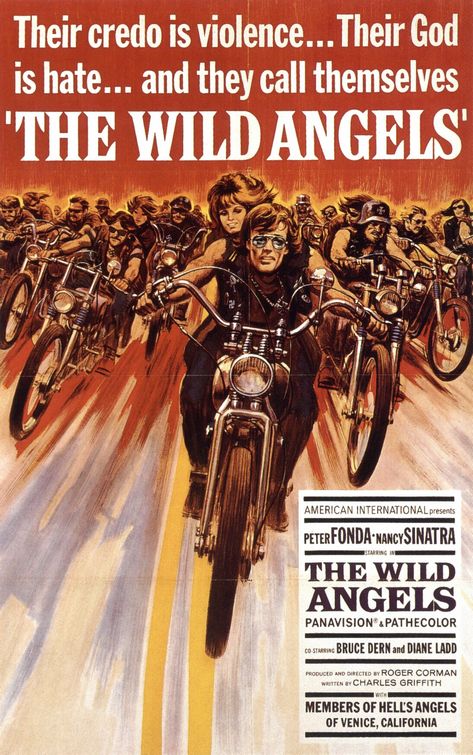
And the matter at hand is The Wild Angels, a film without which the subsequent history of cinema would look wildly different. This was the movie that really kicked off the biker film fad of the middle and late 1960s, not because it was first (biker pictures had been around for over a decade, though their popularity, and the popularity of the juvenile delinquent film more generally, began waning towards the end f the '50s; nor was it the first biker movie of the mid-'60s), but because it was by far the most popular, coming out at the exact moment when the rising notoriety of the Hell's Angels brought the subculture back into the limelight and made the time perfect for a savvy producer to exploit that culture for all it was worth (not incidentally, Hunter S. Thompson's Hell's Angels came out around the same time as the film). And oh, how The Wild Angels had a savvy producer, the savviest of them all: Roger Corman, who also directed, making the film under the aegis of American International Pictures, the most savvy of all bloodlessly mercenary independent film companies.

Anyway, that's not the reason the film had such massive influence, though it's a little bit interesting. The really important thing is that Corman had the good sense to cast in the film's lead role Peter Fonda, an unusually prominent figure in the burgeoning counterculture, owing to his rock-solid establishment bona fides (being the son of Henry Fonda would do that), mixed with his rather showy rejection of that establishment and his retrenchment within the West Coast hippie scene. This gave The Wild Angels an immediate shot of verisimilitude, and even more importantly, it got Fonda to thinking about deeper themes that could be explored using the mechanism of a biker film, and after a couple of years, that development of his onscreen persona and his offscreen philosophy, as initiated by this film, resulted in Easy Rider. And that film's seismic place in the development of American film is both well-known and undeniable.

The Wild Angels has to settle for being a pretty satisfying bit of grimy exploitation, not a cultural flashpoint and medium-altering achievement. And I suppose that's just the way Corman would have wanted it, him being one of cinema's all-time great pragmatists: I do not suppose that anyone would genuinely accuse him of having one-of-a-kind skills with the camera or actors, nor did he ever make a film that fundamentally challenged the way that stories could be communicated visually. But at his height, he was a genius anyway: rare indeed was the filmmaker who could so accurately predict what the audience would want, and when they'd want it, and then make a movie to fulfill that want for a budget that's closer to the cost of a new car than a "real" film production.

Clearly, The Wild Angels scratched some itch for watching the exotic, brutal adventures of barely-disguised Hell's Angels analogues (indeed "barely disguised" is giving the film the benefit of the doubt: the motorcycle club is named specifically in dialogue, and while we never see the Angels' famous death's head logo, the jackets the bikers wear are otherwise dead ringers for the famous, infamous Angel colors). Movies don't create genres without tapping into some deep-seated cultural current. And yet, the most conspicuous reality of The Wild Angels is that it was plainly made by old men who had no real idea about the subculture they were depicting. Corman himself was the very model of a square, far more concerned with how to squeeze every penny out of his projects, and when sociological messages crept into the films he wrote and produced, it seems to be mostly because he didn't see any profit in preventing his screenwriters from squirreling some themes away into the subtext. And he commissioned the script for the film from his good lackey Charles B. Griffith, who was, confessedly, one of the people who threaded some interesting subtexts into his scripts, but certainly couldn't count himself part of the counterculture. Much of the screenplay was rewritten by Peter Bogdanovich, who at least comes closer; but he was more of a film nerd than just about anyone else in a generation of film nerds. And from the onscreen evidence, in which authentic-sounding biker slang is wielded in the most stiff, inorganic way possible, we can go on and assume that nobody involved in putting that screenplay together was practicing anything like embedded journalism in making it happen.

The result - this is the key part - is that The Wild Angels falls into a foggy place where it at once wants to serve as a niche-targeting movie for all the young people beginning to voice the same sentiments about freedom and a lack of responsibility that we hear spoken by the characters onscreen, while pathologising that attitude as proof of the essential hedonist immorality of the characters espousing it. Basically, it's a piece of bikesploitation that deeply fears the dangerous potential of bikers and biker culture, but carries itself like a rabble-rousing cry of passion, in total sympathy with its characters, getting just at outraged at the injustices carried out against them as they are. It's a fucking weird mix of form and message, and I suspect that in the cold light of day, it means that The Wild Angels is an incoherent piece of nonsense; but since I am a Corman booster in good standing, I choose instead to take it as proof of his canny ability to make everyone happy at once. And since the film ended up a hit among the proverbial Kids These Days, he must have done a good job of it.

The Wild Angels is an early example of the "slice of life" picture, telling very little in the way of plot; it has an incident that shapes and guides the entirety of its hour and a half, but there's not nearly enough of that to make for a proper drama, and mostly what we see are people existing, responding to that incident but not with a great deal or urgency or, apparently, sense of things being terribly unique. And this too is part of the Corman school of stretching a buck: show as much talking as possible, at the expense of action, and if the talk is colorful and descriptive enough, nobody is going to very much care. The deal, basically, is that club leader Heavenly Blues (Fonda) has picked up some news that the missing bike belonging to his follower, the Loser (Bruce Dern) has been spotted in Mecca, Mexico. So the Angels say goodbye to their old ladies - Blues with his girlfriend Mike (Nancy Sinatra), Loser to his wife Gaysh (Ladd) - and discover that the bike has been stripped in a chop shop. In the ensuing brawl, the Loser snags a police bike, and a chase follows, leaving him shot, while the rest of the Angels escape. Sensing a trap, Blues nevertheless okays a mission to steal Loser from the hospital, and while they are successful, a nurse that some of the Angels tried to rape - Blues stopping them - identifies them. While the Angels head into Northern California to stage a funeral for their fallen comrade, the police begin to plot their capture of the notorious bikers.

Put it like that, and it sounds action-packed, but in the laconic, character-driven way it unfolds, it barely registers that there's any continuity between scenes at all. It's very existential in its feeling, in fact, certainly pushed in that direction by Fonda's restrained, uninflected performance. By the time the last scene rolls around, with Blues rather despondently giving up all hope - a precursor to the "We blew it" moment from Easy Rider, though played with more dramatic nihilism here than there - the film has been so fully saturated with an elegaic tone thanks to Fonda's work that even when it's at its most alarmed (such as in the borderline campy funeral scene with the Angels profane a church), the film feels more tender and sad than outrageous and exploitative.

But exploitative it is, and alarmist: from the opening credits, in which the "W" in "Wild" is cross-bred with a swastika, the film's insistent comparison of the Angels with brutality, anti-social behavior, and Nazi imagery is pervasive, and at weird odds to its emotional investment in their attempt to find peace, however they define it. I really can't explain it other than to assume that Corman and AIP were openly anxious to get both the bikers and the moralists on their side; that, or they only cared about being salacious and edgy, without reference to anything deeper than "what sells?" At any rate, I have no idea if the film's depiction biker culture is remotely accurate, either in its attempts at realism or its attempts at scare mongering; I just know that it's a weirdly moody, frequently dysfunctional drama whose completely casual depiction of the California underclasses has a raw, realistic tang that studio pictures had an immensely hard time matching, slow as they were to respond to the shifts in culture. And it is never less than fascinating, even when it's clearly not working on any level.

Also, it has a scene where Fonda, disgusted with himself, his lifestyle, the society that wants to tame him and his people, the planet that bore them all, stands alone outside at night, while yowling cats have been foleyed onto the soundtrack so loudly and aggressively - and a whole bunch of different cats, too - that the movie suddenly feels like it's drifted into some kind of avant-garde Catwoman riff. I have no idea how it fits into the rest of the film on any level, but I adore it: it never hurts to forget that, for all their fascinations, the films of Corman and AIP, together and apart, are still basically terrible, and moments like that are glorious reminders of how goofy low-budget B-movies could be.

Elsewhere in American cinema in 1966
-The short Winnie the Pooh and the Honey Tree is the final animated film released by Disney before its namesake's death in December
-John Ford, a man's man of a director, ends his career with the decidedly uncharacteristic 7 Women
-Avant-garde artist and self-aware brand name Andy Warhol makes his mainstream breakthrough with Chelsea Girls

Elsewhere in world cinema in 1966
-Sembène Ousmane's Black Girl, a Senegalese-French co-production, brings sub-Saharan African cinema to international attention
-Italian master Michelangelo Antonioni makes the anti-thriller Blowup in England, documenting and autopsying the newly-forming counterculture
-The criminally under-appreciated and horrifyingly short-lived Soviet filmmaker Larisa Shepitko makes Wings, her first feature after graduating from film school

Thứ Hai, 4 tháng 8, 2014

BLOCKBUSTER HISTORY: SCI-FI COMICS

Every week this summer, we'll be taking an historical tour of the Hollywood blockbuster by examining an older film that is in some way a spiritual precursor to one of the weekend's wide releases. This week: the most outlandish movie yet made by the Marvel film factory, Guardians of the Galaxy, at least wins points for feeling unlike all the other comic book adaptations of recent vintage, looking back to the sci-fi adventures of the '80s. And at least one of those, I am happy to say, was also adapted from graphic literature.

In principle, I adore 1981's Heavy Metal. It represents a kind of science-fiction storytelling inordinately rare in English-language filmmaking, on the model of the anything goes kind of batshit nuts world-creating that went in in things like Weird Tales and Amazing Stories back in their early years; its multiple visual styles are all taken from the pages its namesake magazine, which nurtured some incredibly gifted talents in both comic book art and writing. And it's an animated movie from Canada, which is pretty much all it takes to get me interested.

The downside to being based on Heavy Metal, though, is that the film is, well, based on Heavy Metal: a publication that exemplifies the notion that the euphemism "adult material" almost exclusively denotes content which is chiefly of appeal to people other than adults. 12-year-old boys, to take the age group usually picked in such conversations, and I'm sure that in history there have been many 12-year-old boys of class, refinement, and unusual moral and aesthetic sensitivity. But Heavy Metal doesn't care about them. It is a title premised on the wholly sound observation that you can get a 12-year-old boy to pay any price for a glimpse of tits; even cartoon tits, like the ones here. A little gore here, a little astonishing creation of disparate worlds from across the galaxy there; but mostly it is a film dedicated so making sure that there is as much footage possible of rosy areolae surrounding lovingly drafted erect nipples on breasts the size of volleyballs. It is a film that can imagine planet-spanning conquests between toxic zombies on giant bats fighting spirit warriors from a dead race on a huge pterodactyl, but it can't quite fathom a universe where any of the women wear shirts.

I concede that calling this a "downside" ignores the fact that for Heavy Metal's target audience, it's actually closer to being exactly the point of the thing, and while it's easy to ask a heterosexual adolescent boy, "don't you want more from your art than the constant sexual objectification of physiologically impossible women?", there's no point in being distressed when he answers "no". So on we go to the other really big, heaving problem with Heavy Metal, which is that it's an anthology film: the whole shebang is directed by Gerald Potterton with a screenplay by Daniel Goldberg & Len Blum, which gives it a certain consistency of tone, but it was adapted from stories by a number of different people, and even animated by several different studios. It's just the nature of anthology films, that they are never consistent: some segments are brilliant, some work intermittently, some completely suck. That's the nature of the animal. And Heavy Metal compounds things by wrapping all of its individual stories in a completely perplexing and ineffectual frame narrative in which a glowing green orb from space called the Loc-Nar (Percy Rodriguez) melts an astronaut and torments his daughter by promising her that it is the embodiment of all evil in the universe. And before it does whatever heinous crimes to her that it has in mind, it's going to show her a bunch of its greatest hits, conveniently demonstrating a whole range of the kind of evil that it can engender, in all sorts of varied environments. It's as nonsensical as the moment in The Star Wars Holiday Special where a galaxy-wide red alert demands that we learn something about the corruption of the Rebellion by watching Bea Arthur play a singing bartender. Also, the way that the girl spends the entire frame, interstitials an all, with a single look of aghast terror plastered on her face is wildly out of proportion to the Loc-Nar's rather wandering, businesslike way of presenting its flashbacks.

The worst of the framing narrative doesn't occur until its second or third appearance, though; and happily, the frame is easily the worst individual component of the movie. The only individual story that even comes close to the same low level is "So Beautiful and So Dangerous", based on an Angus McKie story, which depicts a Pentagon secretary (Alice Playten) being abducted to a spaceship by an alien android (Roger Bumpass), at which time she strikes up a sexual affair with a robot voiced by John Candy. The ship's pilots (Harold Ramis and Eugene Levy) are bored and get high, driving the ship into the flight deck of a space station. What in the living hell this has to do with the Loc-Nar's ancient cosmic evil is anybody's guess, and the aimless, dimwitted comedy on display is hardly captivating enough to sell the short on its own merits, particularly coupled with its complete abandonment of its own plot midway through, when it shifts from "abducted women reaches sexual ecstasy with a vibrating robot" to "stoner gags with aliens".

Everything else is at least satisfactory, though the best of the segments by far, "B-17", gets that way by abandoning science fiction for horror (it's adapted from a Dan O'Bannon story, no less), and as such implicitly calls the whole idea of the project into question a bit. It's your basic "alien orb turns dead airmen into skeletal zombies in a bomber during World War II" number, and the undead are rendered with particularly loving care by the animation team on that segment. It's heavy on atmosphere and abruptly short on plot: just creating a mood and getting the hell out of there, and in that respect it's kind of cheating: most of the other segments are at least partially involved in world-building and completely removed from the simpler goals of horror, so it's harder for them to achieve as much without having to work a lot harder for it. But there are other standouts; "Harry Canyon," the first after the framing narrative is established, is probably my favorite of these, a straightforward future-noir piece that's one of the original stories Goldberg & Blum whipped up just for the movie. The crude art style with heavy lines and an exaggerated impulse to realism that defines most, but not quite all of the segments is better suited to the story here than anywhere else; and the narrative is clearer on its own terms than anything else.

The other three segments include the Richard Corben story "Den", a hyper-sexualised "weird fantasy" world story that feels influenced by the work of Lord Dunsany (or rather, one of the countless works influenced by Lord Dunsany throughout the 20th Century), and involving possibly the least appealing animation of all of them; and the Bernie Wrightson story "Captain Sternn", an odd comic bit that has no real ending, nor a beginning. The film's showpiece is the other Goldberg & Blum original, "Taarna", which takes place on a world overrun by toxic mutant barbarians, and involves a woman wearing straps of cloth across her nipples and vagina who speaks no words and swings a big sword, which she acquires in a sequence that I am absolutely certain must have influenced He-Man and the Masters of the Universe, that most beloved of all toy commercials in the guise of a TV cartoon. And indeed, the whole of the segment seems to suggest quite a lot of influence, on that series and anything else you can name where a desert planet with modular buildings is inhabited by sci-fi barbarians: the design is pretty terrific, I will happily concede that. So is the effects animation, including some flying shots that must have absolutely pushed the maximum limit that the budget of a Canadian animated feature could mange in 1981. The story is a confusing, undernourished wreck (uniquely among the segments, it feels like it could only be better with more running time to explore its world and define its rules, and to create more of a personality for its blank protagonist), but it looks nice.

Underneath all of this, we hear plenty of songs that are either heavy metal, or comfortably near to it, or don't come even close but are present anyway (has anyone, in history, tried to argue that Devo was a heavy metal group?). Mostly, the soundtrack feels like somebody wanted to justify the title of the feature, and not that anybody had a driving passion for metal that led them to make cunning and artistically inevitable marriages of music and image, though there's never anything that really feels wrong, just mostly arbitrary. That's largely how the film as a whole feels, too: a bit of inspiration but not enough to support the whole 90-minute running time, and too many of the stories end with a fizzled "so that happened" feeling, rather than the punch that comes from a really good short story collection. It's one of the more unusual corners of the early-'80s "Let's be Star Wars" cottage industry, but not also one of the most effective; and outside of animation buffs, metal historians, and the horny 12-year-old boy who lives in the heart of all of us, there's just not that much reason to bother with it.

Chủ Nhật, 8 tháng 6, 2014

SUMMER OF BLOOD: NOVELTY MASSACRES

If it had done nothing else to distinguish itself, 1982's The Slumber Party Massacre would stand out in the crowded glut of early '80s slasher films by virtue of being written by a feminist. Not, please understand, the kind of everyday feminist that anybody could be who believes in equality between the sexes and calls out discrimination and anti-woman behavior when she sees it: an actual leading light of movement feminism, Rita Mae Brown, the lesbian activist and author of the pioneering novel Rubyfruit Jungle, a radical so devoted to her causes that she publicly sparred with Betty Friedan.

In other words, the last sort of person on Earth who you'd expect to have anything whatsoever to do with a genre that, from almost the first moments of its existence, was being identified (fairly, and often accurately) as being a hotbed of misogyny and the objectification of women, a narrative formula that offered a chance for nervous teenage boys to ogle naked girls and then watch them get sliced in half by sexually puritanical psychopaths, and sometimes very little else besides that.

The story behind this is among the best-known in slasherdom, but we'll run through it real fast anyway. Brown's original screenplay, titled Don't Open the Door, was a parody of the slash form, one that mocked exactly the things that a feminist activist author (or, y'know, a decent human being) would find most problematic about the subgenre: the unmotivated nudity, the violence against women, the phallocentrism of insane men stalking girls and penetrating them over and over again with their long knives, penetrating them to death. And I would be darned interested in seeing the movie she had in mind when she wrote that screenplay. But something happened to Don't Open the Door that Brown wasn't prepared for, which is that Roger Corman got his hands on it. And while Corman was a man who did much good for many independent filmmakers in the horror and thriller genres over the years, he had the soul of an exploitation huckster. There's little room for feminist satire in exploitation films, and Brown's vision was doomed from that moment. In the end, Corman received no official credit as producer, and the film was handed off to an editor in his sphere of influence, Amy Jones (now going professionally as Amy Holden Jones), who made her directorial debut with the film.

Pause for an anecdote: Jones cinched the job by cobbling together an eight-minute prologue to show to Corman. Just a quick and dirty bit of backstory that, as she's observed, looked better than the film itself, despite its on-the-fly nature, because the DP on the project was her husband, Michael Chapman. Which means that at one point in this world, there existed a sequence from a slasher movie shot by the cinematographer of Raging Bull right after he completed that project, and if that's not just the damnedest thing I ever heard. Unpause.

Perhaps owing to an innate lack of humor, and perhaps hoping to please the boss, Jones revised Brown's script to make it more of a straight slasher film and shot it without a trace of obvious comedy, irony, or satire. In fact, despite being helmed by a woman working from an explicitly feminist screenplay, The Slumber Party Massacre somehow manages to be one of the slimiest, trashiest slasher films of the subgenre's early period. It is male gazey in ways most films directed by males can't even manage: in a shower scene which the film lingers on and attends to with a stateliness and unhurried air that recalls the descriptions of battles in War and Peace, there's a shot that starts on a naked woman's soapy back, tracks straight down to look at her ass, looks at it for a few seconds, and tracks back up. If this is satire, it's on some unbelievably rarefied level that I am completely unable to comprehend; there's always the "parody through sheer exaggeration" argument, but that takes a fantastically deft hand, and Jones, who I reiterate was making her directorial debut on a film that had to make money for Roger Corman, does not have that hand. No, woman in the director's seat or not, this is just one big pervy adventure in objectifying the every-loving shit out of every female character the film can get its hands on. As it were.

At any rate, on the face of it, you couldn't ask for a more pure, direct, unimaginative slasher. In Venice, California, a high school basketball player named Trish (Michelle Michaels) is alone at home for the weekend, and she and her three teammates and BFFs have decided to have an old-school slumber party, just for the girls, to relive their glorious days of youth. Those friends include Kim (Debra De Liso) and Jackie (Andree Honore), distinguishable solely in their hair color and skin tone, and Diane (Gina Smika), the designated bitch. This first comes up in the locker room after practice, when Trish suggests inviting the new girl in school and on the team, her next-door neighbor Valerie (Robin Stille); the group consensus is to send the invite, but Diane so noisily complains about what a violation of their group dynamic that would be, with Valerie only about two feet away, that the new girl politely declines and runs home to be with her smutty-minded younger sister Courtney (Jennifer Meyers) all night. To spice things up, Diane's boyfriend John Minor (Jim Boyce), whom the other girls all dislike, is hoping to sneak over to the girls' night to make out and probably more; and a pair of boys, Neil (Joseph Alan Johnson) and Jeff (David Millbern), who are not distinguishable at all, have gotten wind of the party and decide to spend the night peeping in windows.

So that's the Expendable Meat, and the Horny Kids Who Will Die For Their Sexual Trangressions. While all of this has been brewing, we've also been introduced to our killer: Russ Thorn (Michael Villella), a psycho who went on a killing spree man years ago, and who's just escaped from prison. His first onscreen action is to ambush a telephone repairwoman (Jean Vargas) in her van, with a gigantic power drill; this gives him a spooky white vehicle to drive around and appear in the edges of shots, as he heads straight for the high school to gaze at the young women leaving. How he finds out about the slumber party, what his deal is anyway, and whether he has some eerie psychic connection to any of the girls is totally immaterial. He's a psycho killer, they're nubile young women with drugs and drink, and that's an attractive force stronger than gravity.

In 77 minutes that are brief even for junk food horror movies from the '80s, Thorn kills a startlingly large number of people with his massive tool, with Diane's death in particular (not a spoiler; the Designated Bitch never lives) finding Jones and cinematographer Stephen L. Posey consciously framing it as a rape and the drill as a metaphorical penis. And that's it as far as obvious traces of any kind of feminist reading on the slasher genre; there's also the bit where the drillpenis is castrated, but Jones underplays it severely. "Jones underplays it" is a useful phrase to hang onto while watching The Slumber Party Massacre: it's a film rife with things that, even if we don't know the film's history, feel like they're kind of supposed to be jokes, except that they're not playing that way. There's a repeated bit where Trish keeps not noticing news stories about Thorn's escape, and another, even more frequently repeated bit where men who are not the killer and have no apparent ill motives grab women by the throat from behind, and both of these seem kind of like running gags; but they're staged with exactly the same timing and framing as any tension-building beat from any slasher film. There's a defiantly odd scene where the somewhat creepy neighbor, Mr. Contant (Rigg Kennedy) - whose creepiness is not built up at all, not even where he basically tells a bunch of teenage girls that he won't tell on them for smoking pot if they don't mention that he was stalking around the house, wink wink - is out hunting snails at night with a meat cleaver, and that's not even good as comedy, though at least it's explicable. Here it's just treated as a generic false scare.

What we learn from The Slumber Party Massacre ends up having nothing to do with subverting male power, or giving women control, or challenging male gaze, or any goddamn thing at all, but this: when you make a parody and decide not to have any of the jokes be funny, you've basically just made a shitty version of the shitty thing you were parodying, and if there's a distinction between "this is very bad" and "this is an exaggerated version of a bad thing", it's wholly academic. This is a crappy film with bland performances - in a film crazily awash with gratuitous nudity, the actresses willing to show up would be from a rather shallower pool than even the normal slasher film could boast - and a brutally perfunctory plot that almost explicitly treats the undifferentiated characters as dominoes to be set up in the first 40 minutes, so that they can then be killed off at a pretty fucking steady clip. From the 45-minute mark until the film ends 32 minutes later, there's a death, on average, every 3.5 minutes, a pace that would make Jason Voorhees himself stand back impressed. And they are not very interesting deaths, either - one scene, the film's single good one, finds two of the girls unaware that Thorn is creeping in through the window behind him, and it's nicely tense, but the deaths themselves are mostly hidden behind quick cuts (naturally, the boys die in shock moments and the girls get stalked a bit first), and the stage blood looks positively chintzy.

And that's really the worst of it: it's not just bad at the level of storytelling and direction, it's genuinely poorly made. There's a scene early on where Michaels rushes a line and Smika fumbles her through dialogue that suddenly comes across as redundant, and they just left it right there in the damn movie. And the sound - Christ's love, the sound mixing! - if it's not the loudest curtains in the whole wide world being closed with a rustle that sounds like the house's foundation shattering, it's a moment between Trish and a lady carpenter (Pam Canzano) - the presence of multiple women in traditionally male jobs also being something that feels like it's not nearly as important as it could and should be - that includes an amazingly balanced line that goes something like "YOUR BOOKSHELVES WILL BE READY nexsht Tueshday".

It's so easy to see the film that The Slumber Party Massacre isn't quite - the absurdly overly emphatic, self-mocking, weird, and caustically satirical one that may or may not be what Brown had in mind, but would still qualify as a parody - and be angry at it for existing in this half-assed form, but I'll say this for it: it's distinctive as anything. The strain between content and tone leaves it feeling like no other slasher film of that period, and while it also leaves it more frustrating and ineffective and just plain crappy than the great majority of slashers... it stands out. In a subgenre as routine and formulaic as this one had already become by 1982, that counts for an awful lot.

Body Count: 12, not all of whom I actually got around to naming, because of the characters who show up for literally no narrative reason other than to die. Again, if there's a difference between exaggerating for effect and just being trashy, The Slumber Party Massacre does not know what it is.
Breasts: 8, by which I mean 8 distinct occurrences of breasts, not 8 breasts overall; it is in fact six pairs and two individually, some of which are duplicates.
Asses: 4 belonging to girls, 1 belonging to a man in a Playgirl spread.