Hiển thị các bài đăng có nhãn needless spinoffs. Hiển thị tất cả bài đăng

Thứ Sáu, 16 tháng 8, 2013

DISNEY SEQUELS: CRASH AND BURN

That there are two animated films in the summer of 2013 which both feature a creature that just wants to race, doggone it, no matter what institutional bias he faces from the powers-that-be because he belongs to the wrong species, and when he eventually manages to make it into the big show, he ends up squaring off against his idol, now revealed to be a complete asshole, is surprising. That, given this is the case, Turbo (racing snail) would prove to be at least the equal to Planes (racing crop duster) is discouraging. That Planes couldn't even manage to improve upon Cars 2 is downright heartbreaking.

For Planes is, if you've managed to miss hearing about it (and bless your dear innocent heart if that's the case), is a spin-off of Pixar Animation Studio's most widely-dislike films, Cars and Cars 2;* it does not otherwise have a single damn thing to do with Pixar, being as it was animated at India's Prana Animation Studios under the aegis of DisneyToon Studios, the company responsible for all those notorious direct-to-video sequels that John Lasseter ostensibly put a stop to back in 2008, on account of how they were diluting the value of the originals Given that Lasseter is, according to all available evidence, the single biggest fan of the Cars movies, one can barely stand to imagine how much it must have hurt him to executive produce this confounding extension of those movies' alternate universe, and presumably it was only to avoid hurting the feelings of the toy designers who, aw shucks, already had the prototype for the many marketing tie-ins ready for Planes that he did not likewise pull this one off the assembly line some early stage.

There's already enough evidence in this review for you to know exactly where things are going: in middle America, anthropomorphic crop duster Dusty Crophopper (Dane Cook) - pronounced "crawp-hawp-purr", not "crow-fop-per", which I just realised is what it looks like it should be when you see it written down like that - wants to be in the great Wings Across the World race, more than anything. Nobody takes him at all seriously, and he's doing serious damage to his innards by pushing so hard, but eventually he places, barely, in the qualifiers, and now with the aid of WWII veteran Skipper (Stacy Keach) he begins training to become the greatest kind of flyer, one who can compete with such legends of the sport as Mexican Stereotype (Carlos Alazraqui), British Stereotype (John Cleese), French-Canadian Stereotype (Julie Louis-Dreyfus, who's father was French, so apparently that's what makes it okay), and Somewhat Less Odious Indian Stereotype (Priyanka Chopra). You will undoubtedly drop dead of shock when I tell you that the final leg of the race comes down to a one-on-one face-off between Dusty and the complete asshole superstar Ripslinger (Roger Craig Smith).

I am, firstly, impressed that Planes manages to shameless copy both of its predecessors in the Cars franchise, in order - the first third of the movie is the "hotshot kid and crusty old guy" movie, the rest is the "grand prix" movie, and tragically, there are no ghastly redneck caricatures getting involved in an international espionage ring. There's simply not time for it: and whatever else is true of Planes, at least it's blessedly short. All the less time to spend with the thoroughly unlikable characters and tired performances, with Cook attempting a bland knock-off of Owen Wilson that neatly compliment's Keach's feeble impression of Paul Newman.

All the less time, as well, to deal with the mountain of insanity the movie adds to the Cars universe, which was already the strangest place in all of Pixar. This is not a world that benefits from adding too many details, as Cars 2 proved; with Planes, there are so many bizarre wrinkles - starting with the need for crop dusters and the crops they're dusting in a universe that has no animal life and thus no herbivores (there's a tossed-off line that you could force to be a reference to bio-fuels, if you squint) - that it becomes increasingly impossible to take the setting for what it is, and start to wondering Who builds these planes? and Why can you root around in a plane's engine and have a conversation with him at the same time? Wouldn't that be like taking out a human's heart? Why is there a military? And a World War II? Are the planes and the cars evolutionarily linked? Why are there so many of those little forklift people, who seem to be the primary species on the planet, and neither cars nor planes?

Admittedly, questions like these - and many, many others, crop up mostly because Planes offers nothing else to distract you, unless you are a small child (and, to its credit, the small children in the audience when I saw it were thoroughly entertained, though the were also ready for it to be only about one hour long), and thus lack the sophisticated understanding of narrative tropes that allows you to predict, in detail, the exact shape of the film's final 20 minutes, from within the opening 10. There's no substance to the characters or narrative at all; it's the worst kind of storytelling by fiat, in which we are informed that this is the protagonist that we shall find compelling and involving, without there being any good reason to find him either of those things, and that's even without the wall of impenetrable white noise that is Dane Cook attempting his god-damnedest to sound like a callow Jimmy Stewart-style American kid.

It looks... decent, at least. There's nothing wrong with the animation, except in that even Pixar, at the mid-to-late-'00s height of its creative powers, wasn't able to figure out a way to make its cars look entirely appealing, and cars already resemble faces more than planes do (except maybe a Cessna, and there isn't one of those, except for echoes in Dusty's design). So there's something uniquely and consistently unpleasant about looking at the characters, and that's always rough. But the actual rendering and coloring and texturing of these abominations is more than satisfactory; the backgrounds are pretty handsome, though never as lusty and rich as the "don't you fucking love the American Southwest" design mentality in Cars, and there's a terrific storm at sea in the back half of the movie that includes some truly marvelous effects animation. But you are unlikely to walk of Planes thinking that it is a nice thing to have looked; frankly, even enjoying visuals requires a certain degree of engagement that this utterly dull, artistic dead-end of a marketing gimmick refuses to provide. So there you have it: a movie so boring it can't even be pretty.

4/10

Thứ Hai, 5 tháng 8, 2013

BEACH PARTIES: JUST AFTER EIGHT, WE'LL CONGREGATE

It is a matter of debate amongst people whose priorities are severely misplaced whether 1964's Pajama Party is, properly speaking, a part of American International Pictures' beach party franchise or not. It ports over nearly the entire core cast of those films, but nearly all of them are playing different characters. It incorporates Southern California beaches into the story, but that's not really the setting, and that deprives the film of both the surfing stock footage and surf rock that are so tremendously important to the overall effect of the beach movies. On the other hand, AIP obviously wanted to connect the film with its popular series, which was at that point the company's only teen movie concern as it began dedicating itself more and more to horror, and both the title and the ad campaign are clearly meant to evoke the beach movies, even if the content is a little bit askew.

What this leaves us with is a swell laboratory experiment, that does not try to answer the question, "What happens if somebody besides William Asher makes a beach party movie for AIP?", though it ends up doing just that. Pajama Party, you see, was directed by Don Weis, almost exclusively a TV director up to that point, and while I had no small belief that Asher's contributions to the films are easily overlooked and of considerable importance to the ultimate feel and effect of the movies, it's pleasant of Weis to come along and prove me entirely right. Indeed, of the two men prominently missing from Pajama Party, Asher turns out to be leave the far more debilitating gap than Frankie Avalon, who appears in an extended cameo as the leader of the Martian military, leaving it to Tommy Kirk to be Funicello's designated love interest, and reveals in the process just how essential a perfectly plain, vanilla prettyboy with no discernible acting talent can end up being to create a very particular sort of atmosphere.

Allow me to stop teasing and just say it: Pajama Party isn't very good, which is to begin with not much of a surprise, since none of the AIP beach movies are very good - if we are being objective and totally free of sentiment, nothing by AIP is very good - and expecting any random one of them to be suddenly great cinema is to profoundly misunderstand what they are and why the existed. But "good" is somewhat to the side of what a sensible viewer does hope to find with the beach movies, which is a bountiful sense of cartoonish whimsy, time capsule sociology, and shameless delight in bouncy music and bouncy... people.

Pajama Party at least manages to get part of that right: with writer Louis M. Heyward avowedly structuring scenes and gags according to the logic and rhythm of a four-panel comic strip, the film is unabashedly cartoonish, and in a good way. One of the best things about the beach movies is their well-developed sense of the utterly silly, and the flights of pure fantasy, and Pajama Party reaches new heights in this regard, whether it's the fact that the plot - such as it is, and that ain't much - hinges on an invasion force from Mars, or the early gag where a pair of teens enthusiastically Watusi their way out over a pool, look down, realise what they've done, and fall in, in flawless Wile E. Coyote style. Realism not ever being a concern, Pajama Party still represents a major jump ahead for the franchise in this direction, and it sets us on a merry path that will, in due course, arrive at places like Dr. Goldfoot and the Bikini Machine, and The Ghost in the Invisible Bikini.

What the film lacks totally is bounciness, the poppy energy that tends to make the utterly trivial nonsense in all of these movies seem like charmingly simplistic fun and not just careless trash. For it a thin line between dumb that is fun and dumb that is just dumb, and the beach franchise made a habit of staying on the fun side of that line while leaning as far over as possible. That, I think, was the result of Asher's intelligently loose direction, which felt uncommonly in-the-moment considering how far he was from the material's target audience; there is a sense, watching his movies, that he genuinely respects the daft, made-up culture he's depicting and the teenagers he is making it for. With Weis, in Pajama Party, I simply do not get the impression that he really understood or liked what he was doing, and where Asher's camera is constantly right in with the kids, Weis and cinematographer Floyd Crosby stay locked in wide and medium-wide shots, occasionally darting in for a leering shot of some comely teenage bosom or wiggling hips, and even those have the feeling of something put in according to a system, because the movie needs sex in it, than because the filmmakers have an intuitive sense for how the energy of their film is flowing.

It doesn't help that Pajama Party is so unfocused: the absence of Avalon means the absence of the tart, somewhat nasty relationship between his character and Funicello's, and also the low-boil sexuality that came with it, and every single movie in the series was founded on that relationship. There is here no organising A-plot, just a grab-bag of plot strands: Go Go (Kirk) is on a mission from Mars to study the teenagers of Earth and thereby bring a report back to military leader Socum (Avalon) and Big Bang (Don Rickles, playing a sort of variation on his stock character in the series). Meanwhile, a gang of crooks led by J. Sinister Hulk (Jesse White) is attempting to find the rumored huge cache of money hidden in the home of charmingly dotty Aunt Wendy (Elsa Lanchester), whose nephew Big Lunk (Jody McCrea) is sort of dating Connie but not really, especially when he falls in love with Helga (Bobbi Shaw), the buxom Swedish member of the criminal gang. Go Go is taken in by Aunt Wendy, who thinks nothing of having a Martian in the house, though she cautions him to pretend that he's a human named George to everybody else. And just to make sure that there's a traditional fight scene to end things, the Rat Pack motorcycle gang led by the hapless Eric Von Zipper (Harvey Lembeck) has a grudge against the boys' volleyball team that makes up the male contingent of the teen orgy currently staying at Wendy's place.

None of this gels, which is fair, because nobody involved seems to think that it does gel. It's just free-for-all slapstick, disconnected from character concerns of any sort (the romantic travails of the teens are underdeveloped to the point of non-existence). There's a place where this could work, even a place in the AIP teen movie firmament; but Weis doesn't direct it with the kind of loopy fun that would help to get the audience in the same place as the comedy, and so it all just seems shrill. I've never been so grateful in any of these films for Lembeck, I can tell you that; perversely, the absurd comic figure of the other films has a grounding effect here, since he is clearly familiar with it more than anybody else is familiar with anything, and while some of the actors try harder than others (Lanchester especially is hellbent on having a fun time), nobody hits the right tone consistently. And Kirk is a hurtfully bland hero, with no meaningful chemistry between him and his co-star (I have not seen the same year's Disney-produced Funicello/Kirk vehicle The Misadventures of Merlin Jones, and maybe they have something that works there; but I tend to doubt it), nor enough of an Everyboy simplicity that he carries his solo material any better.

The one actor who possibly gives Lembeck a run for his money as the saving grace of anything at all, for a much different reason, is the unlikely figure of silent comedy icon Buster Keaton, making the first of four AIP appearances as a unfathomably tasteless slapstick Native American called Chief Rotten Eagle, part of the thieving gang. Sound comedy was not friendly to Keaton, whose routines where entirely physical and whose acting style was based in a studied non-response that seemed just grotesque when dialogue was happening around him; his career had been long washed up by '64, which is undoubtedly how he got to this pass. Still, there have been few men in all of screen comedy who can even think about competing his level of native talent, and it is astounding, if not necessarily pleasurable, to watch as he bends all his years of training and knowledge on building this one-joke caricature with intelligence and consistency, reacting and non-reacting with exactly the precision and gravity he brought to bear on any of his best films from the '20s. It's a sharp, somewhat mystifying conflict between style and content that is nevertheless interesting in its way, though while Lembeck and, to a smaller degree, Lanchester benefit the film by yoking its dizziness to something recognisable, Keaton arguably damages it even more by operating so massively far above the material that he calls that much more attention to how reedy it is.

All of this results in a film that's not much fun to watch at all: it doesn't look as fun as the earlier movies, the music (stripped of surf-rock overtones) isn't as fun, the actors aren't having enough fun. With "fun" being the primary excuse for these films existing, that can be rightfully described as a debilitating flaw. But that's to be expected with sausage-factory film production of the sort that AIP practiced: the casts and crews would tire of this stuff, and four films into a seven-film cycle, Pajama Party is a natural place for that burnout to first make itself known.

Reviews in this series
Beach Party (Asher, 1963)
Muscle Beach Party (Asher, 1964)
Bikini Beach (Asher, 1964)
Pajama Party (Weis, 1964)
Beach Blanket Bingo (Asher, 1965)
Ski Party (Rafkin, 1965)
How to Stuff a Wild Bikini (Asher, 1965)
The Ghost in the Invisible Bikini (Weis, 1966)

Chủ Nhật, 30 tháng 6, 2013

DISNEY SEQUELS: A TINKER'S DAMN

When John Lasseter was appointed Chief Creative Officer for all animated productions released by the Walt Disney Company in 2006, he inherited a pair of movies that were reasonably far along in their development that he found to be so completely unacceptable in all ways that he could enumerate, he demanded they be essentially scrapped and rebuilt from the start, both of them still managing to come out by their targeted release dates in 2008. One of these was the Walt Disney Feature Animation project American Dog, which was released, one scrapped director later, as Bolt, and it is largely held to be a thoroughly satisfying, not at all world-changing film, though some of us still long to know what the original film, under the guiding hand of Chris Sanders, was going to look like. The other was the direct-to-video DisneyToon Studios film Tinker Bell, about which I can only say: golly Moses, if this is the fixed version...

I am not sure what to call this: a prequel to Peter Pan? A spin-off? The Japanese word gaiden would be perfect, but Peter Pan Gaiden is a title that implies something far more awesome, and probably steampunk-oriented, than Tinker Bell. This is a non-issue, of course; it only matters if we allow that Tinker Bell is a thoughtfully made expansion to the mythology of J.M. Barrie's play and novel, or the Disney films based thereon, and it is of course not that. It's a marketing ploy - an unusually straightforward one, at that. Disney had done spectacularly well with its Disney Princess line of toys and clothes and God knows what all, and once you've plastered those characters on the side of every plastic object that can possibly be sold to a little girl, you start to get itchy for a new horizon to pursue. In this case, the solution was found in the Disney Fairies line, in which Tinker Bell would be teamed with a whole bunch of color-coded pixies with their own carefully modulated personalities, and by starting the series off in the form of early reader books, the company could earnestly promise that it was promoting literacy. But not so much literacy that a series of Fairies movies (which, as much I understand it - and that is not well - take place in a totally different continuity) couldn't be snuck in there. Not to mention the "dress your daughter like a fairy" kiosks at the Disney theme parks.

Considering how soulless its genesis, the shocking thing is that Tinker Bell ends up being kind of fine. On the generic side, but not in a particularly unpleasant way, and the massive separation between it and any iteration of the Pan universe actually makes it easier to think about it without grousing on its failures as a "prequel", which it is only under the narrowest and least definition. Outside of the design and the shape of the island on which things take place, it's connection to Peter Pan is superficial at best, for the scenario that plays out here, and even the character of Tinker Bell herself, are frankly incompatible with anything that went before.

What replaces it is, on its own terms, not completely successful - there are conceptual holes that certainly would not matter to the film's target audience of little girls with disinterested parents, but I'm not in the least ashamed to admit that they mattered to me - and it's miserably over-familiar as a life lessons movie, while presenting characters who are carefully and expertly leeched of any appealing personality. But it's not insulting, and the message is considerably more pragmatic and reasonable than so, so, so much of what Disney wants to communicate to children. Why, the last time we peeked at a Disney video preying on the innocence of little girls, with Disney Princess Enchanted Tales: Follow Your Dreams, it was in service to the timeless message "being a princess is hard, which is why princesses are better than you". Next to that, the Tinker Bell theme that sometimes, no matter how hard you try, you won't be able to succeed at certain things, but it's still possible to be your very best at other things is freakishly universal and downright radical, even if there's just a whisper of "stay in your place, peon" elitism looking in on the edges.

Anyway, the film is an origin story for the title character, voiced by Mae Whitman - yes, her, but with four more of these to go, I don't want to belabor that reference yet. I'd hate to shoot my wad on what's supposed to be a dry run - who is born when a baby laughs its first laugh, as Barrie explained way back in the Edwardian era, where Tinker Bell is at least notionally set. The laugh, embodied as a whisp of seed, travels through time and space to Never Land, where it alights in the corner of that country known as Pixie Hollow, and Queen Clarion (Anjelica Huston, the most overqualified voice actor in the history of Disney's direct-to-video program) of the fairies welcomes the new little girlfairy into the world. Here, a choosing ceremony assigns her to the company of the tinker fairies, and that's how she takes her name. Not that, following Disney's original film (but not Barrie), Tinker Bell is often referred to as merely "Tink", which makes no goddamn sense if everyone around her is also a tinker. Though it does not appear to be part of anybody else's name, which must be really depressing for her.

Over the course of a rather plot-thin hour and a quarter, Tinker Bell will decide that she really doesn't want to be a tinker fairy at all, and would rather be one of the nature fairies who travel to the Mainland - our world - to help change the seasons (making this as much a Fantasia sequel as Peter Pan prequel). The Mainland, incidentally, pretty clearly refers to absolutely nothing but London, so it's not clear if the Never Land fairies are strictly those who are born of London baby laughs, or what; it's all very hollow and banal in expression, and gives us no sense of how the world works, but that's so far away from what Tinker Bell is even pretending to be interested in that I don't know why I brought it up.

Anyway, Tink's four friends - ditzy (and ambiguously sapphic) water fairy Silvermist (Lucy Liu), nervous light fairy Iridessa (Raven-Symoné), kindly animal fairy Fawn (America Ferrera), and sensible garden fairy Rosetta (Kristin Chenoweth) - all try to help train her in the ways of season-fairying, but none of it works, and eventually Vidia (Pamela Adlon), a snide and bullying speed-flying fairy (this is a thing, in this film's narrative universe) tricks Tinker Bell into inadvertently ruining spring. But at long last, the implication the film has been leaning on all along, that her unmatched talent for tinkering can create inventions never before imagined, comes into play, and Tinker Bell revolutionises the fairy season-making process, so that a process that ordinarily takes weeks can be wrapped up in less than a full night.

That's barely even a single episode of television worth of content, though the "let's learn about Pixie Hollow" material at least means that the film never feels like it's tarrying, looking for content. Structurally and mechanically, all of this is perfectly serviceable, workmanlike children's entertainment: it tells a story briskly and efficiently and makes the lesson of that story clear without being tedious. The flaw - the giant flaw - is that it does this through the medium of some deeply boring characters; one-note personality types voiced by one-note performers whose marquee value (such as it is) far outweighs the impact of their vocal performance. Not one of the five central fairies sounds like anything besides an exceptionally chirpy and annoying American twenty-something (even Chenoweth and Liu, who were edging up to 40 at the time), and their inner lives go exactly as far as what is minimally required to keep scenes from hanging together. One supporting character, played by Jesse McCartney, drifts in and out of the plot so fast that the fact the movie obviously expects us to take an immediate liking to him offends me on every aesthetic level I have.

Really, the only distinctive characters are Tinker Bell's two colleagues, Bobble (Rob Paulsen) and Clank (Jeff Bennett); not at all coincidentally, the only two played by professional voice actors, who prove it by indulging in really broad, splashy accents that start out grating and get worse. I said "distinctive", not "good".

They're also the only two who look like much of anything; generally speaking, character design is something that Tinker Bell has a rough time with, though. It was the first fully-rendered computer-animated film made by DisneyToon Studios, and the learning curve is remarkably similar to what Disney proper had to go through with Chicken Little: there's an unlikable sameness to the characters, they have faces which yield only with great reluctance to accommodate changes of emotion, and there's the omnipresent, eye-watering feeling that they're made of molded vinyl, not flesh. It is disquieting in a way that you can't really define what's the problem it's more like an all-encompassing eldritch wrongness.

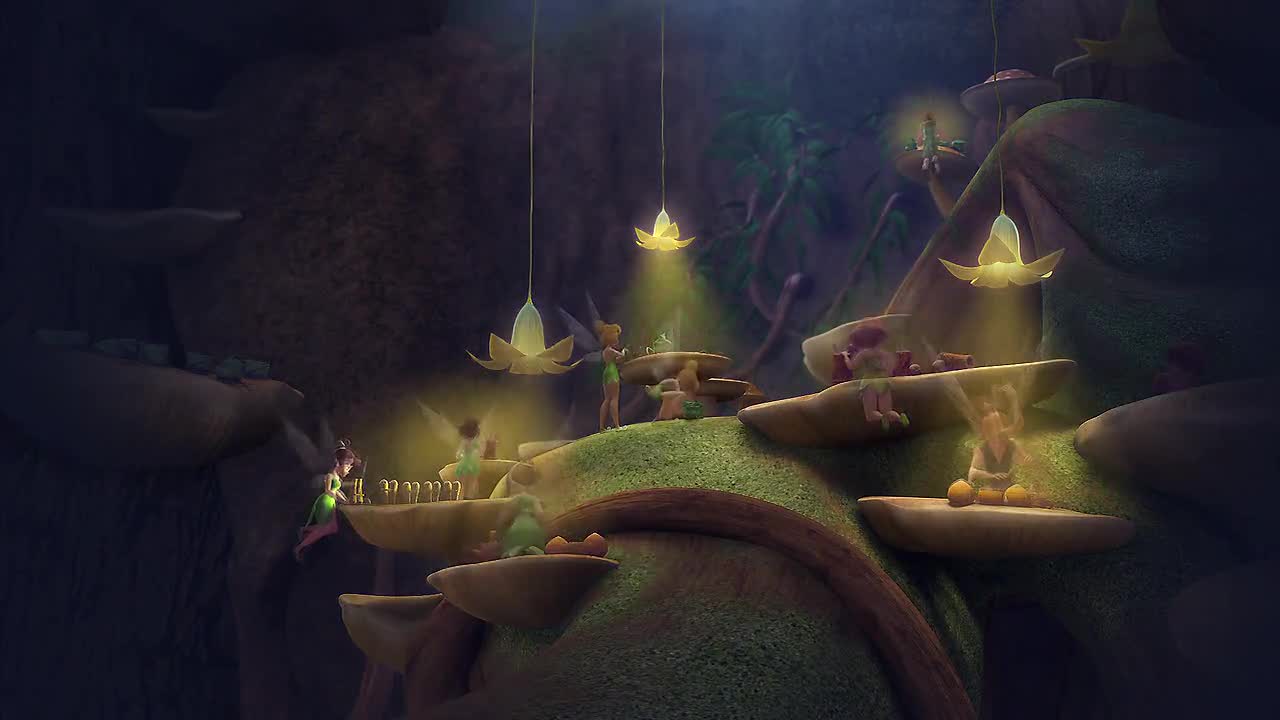
Credit where it's due: the non-character visuals are drop-dead gorgeous. The film's soft color palette does it plenty of favors, and in the many wide shots, it feels very much like the kind of oil paintings treasured by people with only limited taste in art, but a real love of beautiful landscapes and evocative lighting. In fact, the wide shots are probably the single best thing about Tinker Bell, a movie that has very little personality, as befits its status as a feature-length commercial for brand name (which is somehow even worse than a feature-length commercial for toys), and cannot be praised more readily than, "this is emphatically harmless in every possible way". But harmless and pretty? Okay, you've got something there. I'm willing to admit that.