Hiển thị các bài đăng có nhãn ridley scott. Hiển thị tất cả bài đăng

Thứ Bảy, 20 tháng 12, 2014

UNHOLY MOSES

The story of Moses and the exodus of the Hebrews from Pharaonic Egypt is, when you get right down to it, one of the key works of literary narrative in the entire history of the world, so there's no reason a filmmaker shouldn't poke at it. That's what shared foundational texts are there for. So if e.g. Ridley Scott wants to make a movie based on Exodus that puts a rational materialist spin on a story that is, down to its bones, about faith, spirituality, and the immaterial, I can't immediately come up with a reason he oughtn't, outside of a distinct sense that it's probably a very bad idea.

Then again, I might just think it's a very bad idea because I have seen the result of Scott's experiment in applied agnosticism, Exodus: Gods and Kings, and it's terrible in ways that really don't seem possible. Scott is not an untalented man, and this is not his first dramatic action epic set in the ancient world - it's transparently a stab at doing Gladiator with a Biblical tang, though it ends up feeling more like the compromised, ineptly truncated theatrical cut of Kingdom of Heaven (and if Exodus is to have a similarly redemptive director's cut someday, it is well-hidden in the current footage). One can, from time to time, spot Scott the stylist waking up long enough to set the camera someplace for a the kind of immense epic wide shot that does all the things movies do best, particularly later on: the sequence of the Egyptians giving the Hebrews chase to and then into the Red Sea hogs all the best shots, whether it's the ethereal sight of an evacuated seabed, or a mountain collapsing and taking the Egyptians' chariots with it, a string of gaudily gilded ants helplessly tumbling to their death. The film is on much weaker ground the closer it gets to its characters, in all senses: the intensely sharp digital cinematography, courtesy of Dariusz Wolski, is so pristine that it gives everything an unpleasantly crisp sheen that makes the close-ups feel slightly nauseating. Though I shall concede that the punched-up realism provided by this does absolutely splendid things for Janty Yates's costumes and Arthur Max's production design, making the ancient trappings feel very physical present and new, without the distant costume drama feel of so many earlier Bible epics.

But even more than the visuals, it's the story that starts to make one's eyes bleed a bit when it attends to much to the characters. For a story that has been told so many times throughout the centuries and given such definitive cinematic form in Cecil B. DeMille's elaborately campy monument to mid-century kitsch, The Ten Commandments, the assortment of four credited writers charged with getting Exodus whipped into shape did an alarmingly terrible job of it. This is a two and a half hour brick of a movie that spends its sullen time plodding through virtually every plot point and still feels like it has to madly rush to include everything. It's one thing to compare it to the bloated DeMille picture, but this isn't even as smart or comprehensive in its storytelling choices as DreamWorks Animation's 99-minute cartoon musical The Prince of Egypt (which remains, against all odds, the most satisfying cinematic treatment of the story to date). Squatting down to watch Egyptian politicking? Oh, yes, plenty of that. The ten plagues, certainly the most dynamic part of the story outside of the Red Sea passage? The movie burns through those suckers with a haste suggesting that even with a half-committed attempt at giving physically plausible explanations for it (an spike in crocodile activity resulted in clay and blood in the water, which drove out the frogs, which rotted and bred flies...) is a bit embarrassing for the filmmakers to sully themselves with. It's so hectic that it's basically played for morbid comedy, not to the film's benefit, and it gives short shrift to the outstanding, richly cinematic treatment of the death of the firstborn, a moodily-lit dose of paranormal horror that gives Exodus a badly-needed dose of movie-like energy.

Now, taking all that as given, we could still find ourselves with an Exodus telling the durable human story at the heart of the religious parable, which I suspect was Scott & company's goal. And it is here, in fact, that Exodus is at its very worst, since even the shamed depiction of the plagues involves some terrific effects work and the director doing an outstanding job of framing things with a suitable grand, historically weighted scale. But the writing and acting is just dismal, when it comes to the humans. In the lead role, Christian Bale has observed some previously unimagined kinship between Moses and Bruce Wayne, and he plays the part with the quietly self-amused smirk that he honed in his Batman trilogy; the result brings in the wrong kind of modernism, especially when Bale is contesting with the film's oddly-chosen embodiment of God and/or Moses's post-concussion hallucination, a petulant boy played by 11-year-old Isaac Andrews. The sight of Bale looming over a snotty little deity, the both of them swapping arguments about morality in fussy British tones, is curious enough to almost work as parody, which is not apparently what the film was going for. Playing Ramses, the self-indulging pharaoh whose rage against the Israelites drives the story, Joel Edgerton's problems only begin with the well-publicised fact that he's a white dude wearing enough self-tanner that it qualifies brownface. Which is a problem, though Bible movies have been putting white dudes in non-white-dude roles for a century or more. Edgerton is just really damn bad in the part, affecting a haughty demeanor that he can't maintain or turn into plausible line readings, though with some of the lines he has to say - a particular howler is his level response to Moses's demand to free the slaves, "From an economic standpoint alone, what you're asking is problematic" - there's not enough acting talent in the world to salvage things. Still, what Edgerton is up to is a kind of terrible, wonderful experiment in playing camp straight, and leaving us with an impossibly unappealing performance in his wake.

Nobody else in an overstuffed cast gets to make an impression, meaning that among those stuck with a five or ten-minute extended cameo are John Turturro, Sigourney Weaver, Ben Mendelsohn, Hiam Abbass, and Ben Kingsley, who exudes more gravity his tiny handful of scenes than everything else happening anywhere in Exodus can manage cumulatively. The parade of wasted talent, and worse yet, talent that visibly knows it's being wasted, is the most galling part of a movie in which damn near everything is galling: the harsh digital imagery, the incomprehensible pacing, the ungainly attempt to give the ancient story a contemporary emotional feel, the noisy Alberto Iglesias score, the jagged editing by Billy Rich, lurching through scenes with no clear sense of rhythm or pacing. Somewhere at the conceptual stage, all of this had a shot at being interesting, but the execution is so wanting in so many ways that outside of some well-chosen stills of people striking poses against CGI cloudscapes, Exodus offers damn little in the way of entertainment or human interest, and lacks any interest whatsoever as a freshened-up version of one of the best-known stories ever told.

3/10

Thứ Hai, 7 tháng 7, 2014

BLOCKBUSTER HISTORY: ON THE ROAD WITH SUSAN SARANDON

Every week this summer, we'll be taking an historical tour of the Hollywood blockbuster by examining an older film that is in some way a spiritual precursor to one of the weekend's wide releases. This week: Tammy is about being desperate, broke, screwed over by a man, and looking to solve it all by taking to the road with Susan Sarandon as your wingman. Or perhaps it's about being comically fat and comically vulgar. But let us pretend it's the former.

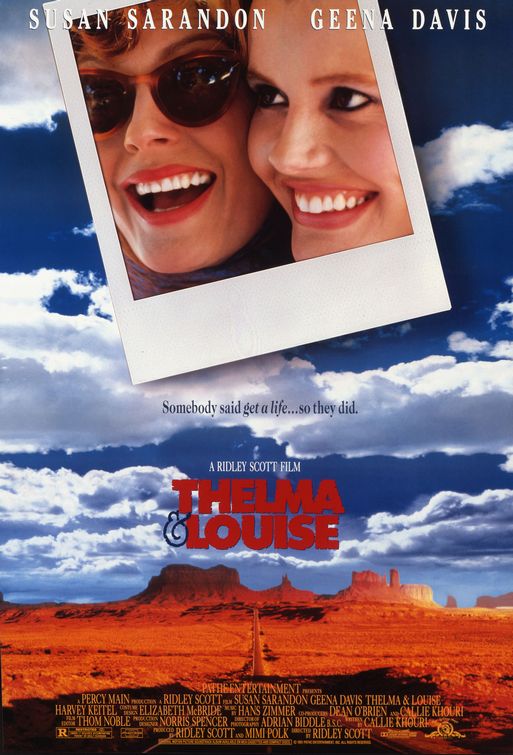
Almost a quarter of a century on, I'm pretty close to certain that the final scene is the most famous thing about Thelma & Louise, so I'm not going to hesitate in talking about it. Bail out if you need to - if there's any way to see the film without knowing where it ends up (I missed my chance by a solid 10 years), you should do it, because it's one of the great American films of the '90s, and the best thing that Ridley Scott ever directed that didn't take place in an impressively designed industrial future.

The reason I lead with the ending, of all things, is because it's the ending, however iconic and perfect, that tends to problematise what the film actually turns out to be, relative to what it's acting like it has been the whole time. Basically, we have a film that looks like empowerment, in which a pair of women who've gotten all fed up with the bullshit of men stop putting up with it, and reclaim their lives. And, having spent an entire film doing that, they die. Now, obviously, there's the defense that they have taken ownership of the most important thing of all - their life and death, which is now not being conceded to the male law enforcement officers surrounding them at the edge of a canyon. But it's a hard thing to describe as "feminist" a movie that only allows its female leads to experience self-empowerment if they pay with their lives at the end of it.

None of which, I want to make absolutely clear, is to say that Thelma & Louise is terribly bad. It's not even to say that it's not still, mostly, a bold and angry statement of feminism; and we could also argue that the film is striking a blow for equality precisely in that it's willing to present its pair of heroines the way that so many male characters have been in so many movies: as likable, relatable characters that we all root for, even as they're doing terrible things and making exaggeratedly bad life choices. It is, after all, an "outlaws on the run" thriller, and those are easy to adore for the complexity of the characters, not for how admirable they are. All that screenwriter Callie Khouri (whose post T&L career - that is to say, the lack thereof - is bizarre and frustrating) did was to apply that framework to a pair of women going through specific experiences that a man wouldn't, and let the characters be who they had to be, even when that means that they're wrong. So maybe it really is feminist. I don't know. As I have a penis, I long ago determined it was best if I prohibit myself from having definitive opinions on these matters.

Anyway, artistic representation and politics are fun to discuss and all, but it's no good to get so stuck in the mud as to lose sight of the fact that Thelma & Louise is an absolutely terrific movie, buoyed up by a pair of tremendous performances from Geena Davis (as Thelma) and Susan Sarandon (as Louise), both of them doing what might easily be declared to be the best work of their careers. Scott's directing is jaw-droppingly good considering how far the material is from what any glance at his films before or since would indicate to be his comfort zone; it has the first truly great score composed by Hans Zimmer; and it's the last film Adrian Biddle shot before his career plummeted into making generic boilerplate crap like 101 Dalmatians, 102 Dalmatians, and the deathless City Slickers II: The Legend of Curly's Gold look at least halfway decent, and the best thing the cinematographer ever did. Any fool who can at least use the focus ring correctly can make the Southwest of the United States look like the most gorgeous landscape created by God in a particularly dramatic mood; but there is true greatness in making the California and Utah landscapes where Thelma & Louise was shot (though no scene in the travelogue takes place in either of those states) look the way Biddle did. The film relies, to a degree that isn't given sufficient credit, on its use of two color families to define the conflict and drive the narrative, and Biddle succeeds here in reducing the landscape to piercing, pungent expressions of just those colors: the hard orange of the earth, the creamy blue of the sky.

What I had never realised before was that Thelma & Louise is, in fact, an early example of the old "orange and teal" trick that would, 15 years or more after its release, come to ruin visual expression in mainstream cinema; perhaps because it had to be done knowingly and purposefully and above all, in advance, with no relying on digital tinkering in post to boost all the colors to a point that Vincente Minnelli wouldn't have been able to imagine in his nightmares, Thelma & Louise also has a more useful and effective presentation of those colors. Basically, blue and orange don't dominate the film simply because they contrast nicely with each other (though God knows they do), but because of what that contrast connotes. Basically, Biddle and Scott use color-coding to divide the film into "teams", or rather to use the colors to explain what team is "winning". Blue and related colors are, in this film, exceptionally sleek and exceptionally cold, and it is always used to define spaces dominated by men. Orange, yellow, brown, and all sorts of earth tones, are warm, associated with light sources, and come to the fore in moments when Thelma and Louise are free to be themselves. The first we see of Louise, in the opening shot of the main movie after the picturesque landscape photography beneath the credits (given hazy, half-menacing, half-dreamy emphasis by Zimmer's zoned-out main theme; apparently, Scott only included an opening credit sequence after hearing Zimmer's music and deciding it needed a special moment to be foregrounded), is as part of an undifferentiated mass of human activity in a diner where she waits tables under a manager with a deeply unimaginative sense of leering and flirting; and this space is bright and very cool and blue. Thelma is introduced moments later, in a hushed and quiet home she shares with her bullying husband Darryl (Christopher McDonald); it is dim and so harsh in its metallic blues as to feel like a robot's innards. When the women leave on their road trip, it's in Louise's shiny green car, the one object that obviously sits outside of the film's duochromatic scheme, and which is situated in the frame in a way that emphasises its sleekness and potential energy, pointing off at the dusty, bright ground where the adventurers are about to escape the chilling blue that dominates and defines their everyday life. And so it is throughout: every time the women are being in some way trapped by men - rapists, hunky thieves, Louise's boyfriend, cops - blues start to creep in and dominate, as the film loses visual warmth by the frame.

It's absolutely gorgeous filmmaking, and would be even if Khouri's script wasn't so smartly balanced - it's a road trip movie in which every scene feels like it's building on the one before, rather than simply stringing along incidents in a more-or-less dramatic arc, which is impressive even without bringing the sharp characteristations into it - or Scott's direction so focused and tense. At 129 minutes, Thelma & Louise is awfully long for a story that could have been told in a '70s exploitation picture (which, in a lot of ways, it resembles) in two-thirds the running time, and it keeps ditching to scenes of the primary investigator Hal Slocumb (Harvey Keitel) hunting the women while sympathising with them, among other, even more disposable moments; yet it flies by and never feels like there's even a single moment wasted. The amount of visual variety helps with that (the contrast between snug close-ups and extremely wide panoramas filling up the anamorphic widescreen frame is marvelous), and so do the tremendous lead performances; Davis at her best isn't up to pulling attention from Sarandon, but the latter actress is absolutely not selfish, and the interplay between the two actors is fresh and relaxed and joyful, while their individual highlights showcase all sorts of marvelous character detail - Sarandon's exquisite body acting during a phone call with her boyfriend (Michael Madsen), all twisted up and nervous and clenched; Davis's schoolgirlish slavering over the hunky hitchhiker played by fresh new discovery Brad Pitt (whom the camera happily ogles, an impressive feat given all the straight men making the film). And it has some absolutely flawless line deliveries: Davis's blunt, authoritative "How long before we're in goddamn Mexico", with a look of perfect clarity and strength on her face, or Sarandon's "The scene of our last goddamn crime!" spoken with an enthusiasm and humor that come from nowhere and is positively electrifying.

The thing's not perfect: in his 1991 review, Roger Ebert adroitly noticed that the final freeze frame fades to white with "unseemly haste", and it certainly does feel like the movie suddenly jams to a halt, like a roller coaster that flings you against the safety bar when you pull into the unloading station, and it takes a lot of wind out of the whole feature. But it's freakishly close to perfection, full of tremendously smart images cut together by Thom Noble with a lot of tumbling momentum and a hint of irony (the cutting seems to be as eager to get away from Darryl as Thelma is), a whole host of outstanding supporting performances from basically everybody, and Sarandon and Davis lording over everything with two of the best roles mainstream Hollywood gave to any actresses during the whole of the 1990s. It's a smart deconstruction of social norms and an exciting, fun, tight thriller, and neither of those successes ever gets in the way of the other; basically, this is the kind of film that one wishes every mainstream movie would aspire to be, and it succeeds in almost every way at fulfilling those aspirations.

Thứ Năm, 31 tháng 10, 2013

LAWYER, GUNS, AND MONEY

The primary characteristic of Cormac McCarthy's novels, it has seemed to me, is terseness. His plots and scenes come along bluntly and quickly, like a swift punch to the windpipe, his characters speak barely at all, and frequently only state absolutely essential facts when they do. So why, oh why, is The Counselor, McCarthy's first original screenplay at the pixieish age of 80, so bogged down with scenes packed with characters who Don't. Shut. The fuck. Up? Mournful prose poetry put into the mouths of characters delivering philosophical monologues are also characteristic of McCarthy, but only as flavoring, never as a main course. At times it feels like there's nothing else in this movie but philosophically dense, stylistically overwrought speeches, and this is the first and most dire symptom of a screenplay that proves most conclusively that being a tremendously great writer of narrative prose requires a different skill set than being a great, or even semi-competent, writer of movie scripts.

The content of The Counselor - using the word "plot" to describe it begs the question - follows an unnamed lawyer (Michael Fassbender) who needs some fast money, and so decides to go in for just this one deal! with a big-time drug smuggler, Reiner (Javier Bardem), and his business associate Westray (Brad Pitt). As this situation is going along nice and smoothly, one of the counselor's imprisoned clients, Ruth (Rosie Perez), asks him to bail out her son for a measly $400. What neither of them know is that her son (Richard Cabral) is obliquely connected with the cartel shipping the drugs that the counselor's money is attached to, and that he's being targeted in this capacity by a couple of henchmen hired by Reiner's girlfriend Malkina (Cameron Diaz) to steal the shipment. When this has been successfully done, the cartel bigwigs quickly discover the connection between the dead Mexican boy and the counselor, and immediately begin the process of exact vengeance upon him, Westray, and Reiner, endangering the life of the counselor's new fiancée Laura (Penélope Cruz).

When one puts it that way, it looks so neat! And so perfectly in-line with McCarthy's themes; objectively speaking, the counselor does none of the things that the cartel punishes him for, but it's the easiest thing in the world to read this as the wages of making that one decision to get involved in one drug deal: start off done an immoral road, and that's where you'll stay forever and always, suggests the story, with the author's characteristic nihilistic pessimism.

Good for the simple, neat version. In reality, The Counselor is a sprawling fantasia of narrative loops and spurious moments and big showstopper scenes that are of exactly zero use on a narrative or psychological level (that infamous scene everybody knows about where Cameron Diaz's character rubs her genitalia on a windshield? Cut it out and the movie would be functionally identical, if a bit less interesting to discuss). Scenes abut scenes in a freakishly modular way, leaving the film absolutely nothing that resembles "flow", just an assemblage of events that don't necessarily need to take place in the order in which they occur. It's jaw-dropping, messy, tedious. In its stripped-down version, the story of The Counselor is something that has been told in approximately this way dozens of times, so that there is nothing of novelty left to it. In its ungainly, inchoate form as it exists, it's as if the film is actively trying to compensate for this fact.

All of this could, I suspect, have been made delightfully kinetic and fucked-up and watchable; it would never be a good screenplay, but it good be an enthusiastically trashy, exciting movie anyway. Frankly, I think that its present director, Ridley Scott, could even have been the one to make that film, though it would have required a decisive break from his recent work and a return to the glitzier style of his now more than a decade-old Hannibal and Black Hawk Down. But that Ridley Scott didn't show up at all, and if I was able to get 600 words into a review of a movie by a major director without mentioning that director's name, it's for the most depressing reason imaginable: this is a very boringly-directed film. Sure, it's handsome enough, and Scott and the ever-reliable cinematographer Dariusz Wolski find a few really striking visuals (though it's probably telling that the absolute best images in the film, both in terms of their beauty and their creativity, are found in the film's somewhat spurious early detour to Amsterdam), though the ever-reliable editor Pietro Scalia appears to have little interest in joining the visuals in any inspired way. You would never say of The Counselor, "this was assembled by untalented people".

You might very well, however, say, "this was assembled by talented hacks", for the whole thing lacks much of anything that resembles aesthetic spark or vitality. It's certainly Scott's most overall anonymous work of directing since his ghastly career nadir of A Good Year, in 2006, in which he challenged himself by proving that you can make the French wine country look beautiful at sunset. In a film where the script is such a bent mess of half-formed ideas that it needed, urgently, a strong hand at the wheel to keep things alive, it's deadly that Scott's main decision seems to have stemmed from the believe that a depressing script needs to be treated somberly, and so the thing is just a grim-faced slog.

This is bad for the deranged, violent detours of the plot, but worst of all for the actors, not one of whom emerges with their dignity fully intact (Cruz is, by far, the healthiest survivor). Fassbender is completely lost in his accent, San Antonio by way of County Cork, and Diaz is hilariously awful and miscast as a sexually omnivorous femme fatale wearing the worst dresses I have seen in a movie in 2013; they both feel like they're children play-acting a druggy noir rather than professionals in a major film. Bardem (with yet another weirdo hairdo) and Pitt at least feel like humans, though humans who have a rough time managing McCarthy's florid dialogue, and in Pitt's case especially, the film's refusal to let be very amusing in any way.

It's such a miserable film, and not just because it is so punishingly severe about what it does to its characters (and with a fairly unmissable slice of misogyny to boot, stalled as it is in an unbelievably straightforward Madonna/Whore dichotomy with Laura and Malkina). It's miserable because it's so fucking uninspired and draggy and generic, no matter how much talent is involved in the cast and crew. I gather that it has become a much-hated film, and I almost wish I felt that way about it; as it stands, there's so much steely blandness that I can't even work up enough enthusiasm to loathe this. Boredom unfortunately, isn't active enough to engender that kind of passion.

4/10