Thứ Năm, 10 tháng 7, 2014

SUMMER OF BLOOD, WEEK 8 POLL: ITALIAN SLASHERS

VOTING CLOSED - WINNER: THE NEW YORK RIPPER
Thanks to everyone who voted!

With sadly amusing redundancy, the slasher film, descended in so many ways from the Italian gialli of the '60s and '70s, traveled back east after it had firmly established itself in the States. Italian genre filmmakers being among the deftest rip-off artists in all cinema, it was inevitable that they'd start to copy the cheap and hugely profitable films coming out in America; almost as inevitable as the development that found those rip-offs wallowing in a degree of crassness and tastelessness that outdid all but the worst American slashers, let alone the stylish, elegant gialli.

I've gamed things by picking three films by significant filmmakers - Deodato, Fulci, Argento - though significance, in these cases, does not mean that any of the films are any damn good.

Body Count (1986)
From IMDb: "A group of teens are stalked and killed by a Shaman at a cursed camping site."

The New York Ripper (1982)
From IMDb: "A burned-out New York police detective teams up with a college psychoanalyst to track down a vicious serial killer randomly stalking and killing various young women around the city."

Trauma (1993)
From IMDb: "A young man tries to help a teenage European girl whom escaped from a clinic hospital after witnessing the murder of her parents by a serial killer and they try to find the killer before the killer finds them."

Or write something in!

This poll closes on Thursday, 10 July, at 11:00 PM CDT (GMT -5:00)!


ECHO... ECHO... CHO... O

It's so easy to compare Earth to Echo to E.T. The Extra-Terrestrial that it would feel disingenuous not to. Both are about children from suburban subdivisions encountering an extra-terrestrial being; both are metaphors for the experience of being a child in a subdivision, though here things start to break: E.T. is about childhood isolation and friendlessness, while Earth to Echo is about kids who already have friends - in fact, it splits protagonist duties three ways - and the alien serves as a metaphor for their awareness that in the next few days, they'll all be living in different states. And while E.T. uses the relationship between boy and alien as a very clear, very moving organising metaphor, Earth to Echo is sloppy and muddy and it is a metaphor for an emotional process more because the movie says it is, than because it has done the necessary work to prove it.

Although, the point remains that it at least attempts to have that kind of metaphor, and that makes it better than a lot of kids' movies, which seem at best to have a fairly patronising, if not altogether hate-filled attitude about kids. For all its litany of failures at cinema and as a narrative, Earth to Echo at least manages to treat with all due dignity the dramatic conflict about three boys (it's incredibly difficult to tell from the material presented onscreen if they're meant to be young high schoolers or old middle schoolers) who are convinced that life itself is about to end because they're apart to have the first major social separation of their young lives. At no point does the film ever condescend to this theme: it presents it with the autumnal sorrow that a chaos-ridden teen might actually feel in the face of such a life-altering event, and refuses to bring a grown-up perspective to the characters' lives. And for this, at least, I admire it, since I have the feeling that I need to admire it for something.

The film takes the shape of a documentary made after the fact by one of the main participants, the camera-addicted Tuck (Brian "Astro" Bradley). Which means, yes, it's another one of those damn first-person movies (by this point, the description "found footage" no longer feels correct enough to use), though one that at least preemptively explains why the characters lug cameras around all the time. Initially, Tuck wants to film an agitprop piece about the freeway construction project about to destroy the Nevada community where he and his friends live; this eventually turns into an exposé of the conspiracy to find and detain an extraterrestrial, with the construction project a pretext to clear out an area where the alien's ship appears to be buried. But that suggests that Earth to Echo has a much more definitive, sturdy shape than it actually does: it actually plays as a series of fetch quests, with Tuck and his two BFFs, Alex (Teo Halm) and Munch (Reese Hartwig), using their smartphones, all of them weirdly garbled but depicting what look like maps, to find, first, a small alien being the size of a squirrel that communicates only in beeps - they name it Echo and decree it to be a male - and then to find the pieces of metal that he can manipulate using telekinetic powers into parts to rebuild his spaceship, which beggars all my comparative skills by being, in fact, about the exact size of a breadbox. Along the way, the trio picks up a girl, Emma (Ella Wahlestedt), and there is some hint of class resentment between her and Alex, in addition to the expected adolescent sexual tension, though perhaps realising that they're making a children's movie, in the United States, the filmmakers drop that theme after its first appearance.

The film gains absolutely nothing from its first-person aesthetic, and there's at least a few minutes of Echo POV footage that straight-up defy the explanation we've been given for that aesthetic, but the style is at this point too entrenched to die for at least a few more years, so the best thing to do is to grit your teeth and ignore it, rather than try to logic it out, I've long since decided. Take that away, and Earth to Echo is a perfectly ordinary attempt at "doing a Spielberg", done with a perfectly satisfactory if derivative story by Henry Gayden & Andrew Panay, and noticeably droopy direction from Dave Green, all of them making their feature debuts. If the film has a problem, instead of at least a handful, it's that the filmmakers are willing to let clichés do the work for them, even when that makes no sense: the character of Munch is written with the peculiar interests and awkward social tendencies of the Fat Kid, given a Fat Kid name, and Hartwig is directed to play the Fat Kid body language, despite not actually being fat. That's an extreme, but every characterisation seems to have been imported without change from the Big Book of Kids' Adventure Movie Templates, especially the deeply thankless figure of the Token Girl. I'll cop to respecting the filmmakers for making the vaguely nerdish Tuck black, and not having that be an important or commented-upon detail, but just something in the background.

The stock characters are really more a symptom than anything, though, of a certain slack, "let's get through this, already" attitude to storytelling that pervades everything. Echo, looking like a cross between the mechanical owl from Clash of the Titans and a Disney rodent, is fairly adorable, and used just sparingly enough to remain special throughout the movie, but it's a film otherwise devoid of creative, impressive visuals (that's the damn first-person gimmick for you, ain't it?), and there's no real emotional depth to it, no point where the film reaches inside your chest and wrings your heart. No matter how many times Halm looks distraught and wan, the film never makes the case for what this story actually means to the characters, and only the framing drama of the impending move really gives Earth to Echo much of any heft, while it fails to inform most of the central 45 minutes whatsoever. It's that peculiar hollowness that makes the film so aimless, even more than the copycat story and dramatis personae. Green and company know the notes from looking at the films of their own childhood, but they don't have the soul to play them right, and while the film is a perfectly sound waste of 89 minutes, I can't imagine anyone in years to come ever regarding it as a precious relic of their youth.

5/10

Thứ Tư, 9 tháng 7, 2014

HOLLYWOOD CENTURY, 1957: In which we could spin a whole metaphor about the conflict between the Old Hollywood of the '30s and the new indie vanguard of the '50s, or we could just go "old guy, young hot chick", and you'd all know what we mean

The Hollywood Century project has been primarily concerned with charting the history of the major Hollywood studios, but it has also been an attempt to track the evolution of American filmmaking over a one-hundred year period, and as we make our way through the '50s, we have come across one of the truly seismic events in both of those histories. For it was in the '50s that the Hollywood studio system began to crumble from the industry-defining behemoth of the pre-World War II era, to the... okay, so the Hollywood studios have always defined the industry, and continue to do so even as the American marketplace itself no longer has nearly the international significance it did even as recently as ten years ago.

But the point is, there came a time when the studio system realised that it was weak: it was when the directors and stars who had till then been contracted for their entire lives to crank out movies like engine parts, and when antitrust laws broke the back of the top-down production/distribution/exhibition structure. It was when independent cinema and more importantly, independent filmmakers became a force: when indie filmmaking wasn't just a fringe wilderness where minorities and subcultures had a cinematic voice if not necessarily an audience, but when indie filmmaking became an outlet for some of the best and brightest and most visible talents in American film.

We are now arrived at one of these huge, polished indies that looks for all the world like it should be one of the many studio pictures of the same era: 1957's Love in the Afternoon, directed by Billy Wilder, co-written by Wilder and I.A.L. Diamond, in their first of 12 collaborations, and starring Gary Cooper and Audrey Hepburn. Shot entirely in in France, it acts like a well-heeled glamorous production, but it was entirely financed by Wilder's company and by Allied Artists, which had formerly been Monogram, the most prominent of all the Poverty Row production companies.

You'd never know it: in terms of the way it was put together, the way it treats the taboo subject of sex, and its starry cast, it's not meaningfully different from Wilder's production of The Seven Year Itch for Fox, two years prior. And this is exactly my point: the directors-gone-rogue like Wilder, Otto Preminger, John Ford, and so on, had largely succeeded in stealing the bag out from underneath Hollywood and making films that you'd have never been able to tell apart from the "real thing", if you will, and they could do it without the lumbering apparatus and the cost. And through the '50s but especially into the '60s, that apparatus became quite lumbering and costly indeed. It takes only a very tiny imagination to see the equivalent in the explosion of indies in the 1990s, and even moreso the rise of digital distribution and Kickstarter and microbudgets in the late 2000s and the 2010s, in tandem with the increase through every year of the 21st Century of high-budget tentpoles that grow more expensive and more burly with every year, but as we do not know when our own equivalent to the New Hollywood Cinema of the late '60s will arrive, or what form it will take, it is better to leave this comparison as an open-ended topic of discussion.

So much for the history lesson, and the speculative fiction. At some point, we need to actually butt heads with Love in the Afternoon, which for all its value in illustrating the shifts the film industry was going through in the '50s - and we haven't even exhausted that part of it yet! - is very unmistakably minor Wilder; the comparison to The Seven Year Itch is neither idle nor accidental, because both feel cut from similar cloth, that of a director who had proven a lot in the early stage of his career and would find interesting new ways to challenge himself in the very near future - later in '57, in fact, with the sterling Witness for the Prosecution - seemed stuck in a place of uninspired regurgitation and autopilot gags. Mind you, Wilder and Diamond on autopilot are still Wilder and Diamond, and I'd rather watch Love in the Afternoon than a great many comedies of the same kind from the same period, even as I'd rank it much nearer the bottom of Wilder's career than the top.

The film is straightforward sex farce: Claude Chavasse (Maurice Chevalier) is a private investigator in Paris, with a powerfully innocent daughter Ariane (Audrey Hepburn), who studies cello and learns the ways of the world from her father's sordid case files in the off-hours. It happens that one particular case - in voiceover, Chavasse only refers to the client as "Monsieur X" (John McGiver), to avoid scandal - results, like so many, with a devastated husband convinced of his wife's infidelity, and ravings about how he's going to go and shoot both of the guilty parties. This particular time, Ariane happens to hear, and horrified by the thought of murder, she manages to infiltrate the adulterous wife's date with legendary American lothario Frank Flannagan (Cary Cooper) in time to avoid tragedy, letting Monsieur X live the rest of his days in beatific contentment and belief in spousal fidelity. Claude is confused by the extreme failure of his research, particularly as it involved such a notorious playboy as Flannagan; he's even more confused by the change in attitude that sneaks over Ariane, who has of course fallen instantly in love with the shallow American. Looking to inoculate herself against his casual attitude towards sex, she builds herself a past of extraordinary debauchery, weaving together the history of her father's cases into a single narrative of one young woman's astonishingly prolific sexual history. Flannagan is intimidated and outraged as only a man so deeply invested in male sexual dominance could be, but he has enough doubt that he decides to hire a private investigator to find out if his lover - whom he knows only as Thin Girl, since she refuses to share her name - is treating him as shabbily as he has planned to treat her. And of course, he would end up requesting the assistance of no other investigator than a certain Claude Chavasse.

Fleet, fizzy, delightful nonsense, right? Right, except that the one thing Love in the Afternoon absolutely is not, is "fleet". It clocks in at 129 minutes, in keeping with many of Wilder's later comedies: the magnificent Some Like It Hot is only nine minutes shorter. But most films are not Some Like It Hot. And while we're still ages away from the likes of the burdensome Irma la Douce, there's really not a single moment in the entire first hour of Love in the Afternoon where it doesn't seem obvious that it could be tightened up to its extreme benefit. Ariane and Flannagan don't even meet for something close to a half of an hour; the development where she decides to fake a complicated sexual backstory isn't until the backside of a year-long gap in the narrative, and the twist that her father is to start investigating her happens over three-quarters of the way through. I don't possess the imagination to not compare this to The Lady Eve, which presents a superficially similar scenario (woman gets back at the guy who wronged her by inventing an overzealous history of sexual partners) and rockets by at 94 minutes, only pausing for a short break midway to let us catch up and catch our breath.

And it's not simply that such a fluffy pastry of a story is dragged out to lack the headlong spark which might put the whole thing over: most of the individual moments are sluggish. Like an opening montage, great, vintage Wilder in many ways, which finds Chevalier expressing in the romantically slutty way that he did so well that Parisians like to fuck and fuck and fuck, with dashed-off images of kisses and hugs blithely illustrating his recitation; there's a particular moment where we see a young couple on a street corner making out, as one of those big street cleaners that shoots water all over the curb approaches them, and we can tell, of course, they're going to get blasted by the street cleaner and keep on making out without even noticing. Simple, straightforward, pleasingly corny gag. Except the shot goes on for just, I swear to God, hours, like you could run into the kitchen and whip up a batch of croissants from scratch all while waiting for that damn street cleaner to catch up to those kids. It's just not funny. Funny is hearing Chevalier say something dirty, bang, water, bang, punchline, move on. This is just sluggish.

The movie doesn't pop, is the problem, and Billy Wilder comedies need to pop. Even Billy Wilder dramas need to pop. Worse still, Love in the Afternoon is fairly transparently his attempt to pay homage to his mentor and creator of the greatest sex comedies in sound cinema, Ernst Lubitsch; the film's best moments (and it actually has many best moments, despite all the shitty things I'm saying about it) are all obviously taken from the Lubitsch handbook, like a fantastic sequence in which a depressed Flannagan gets increasingly drunk while shoving a cart full of champagne to his omnipresent romantic string quartet of gypsies, who keep shoving it back for refills - it's hard to describe it and make it sound funny, let along Lubitsh-like, but the way it's cut is beautiful. Or the unforced way the film allows us to notice how Ariane changes her hair to a more grown-up style every time she wants to impress Flannagan, but goes back to pigtails to be around her father. Or the film's highlight, where Ariane stares at her father's scrapbook of Flannagan's exploits while playing cello, and her increasingly toneless scraping exactly maps to her blossoming interest in the man.

Lubitsch films aren't exactly fast-paced in the way that I'm arguing Love in the Afternoon needs to be; but they did have a quickness and refusal to let the wrong moments bog down. They are light, some of the lightest movies ever made. Wilder could do that; it's not his only Lubitsch riff, though it is his most sustained and his most obvious. But he wasn't doing it here, and the movie just drags on - there are enough absolutely wonderful moments at just the right places to keep the film from ever turning into a full-on slog. And Lubitsch veteran Chevalier is at his most smutty old man charming. Still, it drags.

I'm inclined to say that this logy pace is the real culprit that keeps the film mired securely in borderline-mediocrity, and not the flaw that's almost always cited as its biggest problem: the 28-year age gap - and more importantly, how impressively visible that gap is onscreen - between the romantic leads Cooper and Hepburn. For reasons that remain mystifying to me even as they are disgusting, Hepburn was peculiarly prone to getting paired with men old enough to be her father: Fred Astaire, Rex Harrison, and Cary Grant (who actually turned down the Cooper role in this film, on account of feeling too old for her; guess something changed his mind) were among those that Hepburn had to feign some kind of sexual attraction for, and Buddy Ebsen (younger than any other man I've named - besting Harrison by less than a month) played the older husband she ran away from in the backstory of Breakfast at Tiffany's. Wilder himself had pushed her towards an epically craggy Humprey Bogart four years earlier, in Sabrina (another role Grant passed on). And all of these are better films, or at least are perceived as being better films (I have my grave doubts about My Fair Lady). Certainly, while there's not a one of them where the relationship between Audrey and whatever granddad is making passes at her feels anything but vaguely icky, and heck, this isn't even the worst of them (Bogart is, like, really worn out in Sabrina, and obviously not enjoying himself), but it's certainly the one where the least amount of distraction comes in between us and the May-December shenanigans onscreen. There's no momentum to carry us over the worst parts.

When Love in the Afternoon slows down, it seems at times to be doing it to engage in some kind of romantic gauziness, but it's only really allowing us to fully marinate in Ariane's self-loathing, hopeless long for Flannagan, and whenever the film showcases Cooper in his full maturity next to Hepburn's bright youthfulness, it's really damn hard to believe. It's one thing to have a Cary Grant oozing charm; Cooper was reserved and plain enough that just playing a legendary lover would be a stretch in the best circumstances. But doing it in a way that could plausibly convince us that a stereotypical Parisian gamine would turn herself inside out over him? I don't see it. Love works in mysterious ways, but despite all of her careful effort to make Ariane plausibly aware that she's in over her head with a far more practiced and dangerous lover, Hepburn never convinces that this lover in place of any other would generate that kind of loyalty and passion.

The film moves slowly enough to make sure that we have plenty of time to notice all that; it moves slowly enough that the jokes don't have a chance to build up a head of steam and turn into outright comedy, instead of the nonstop charming register that the film seems quite happy to reside in for most of its running time. I think I liked it, overall: there are a good number of inspired scenes, and plenty of spiky lines of dialogue, but for the most part, Love in the Afternoon is simply too damn sleepy to have any electricity, and that sleepiness comes at a dire cost in selling the human element of the film.

Elsewhere in American cinema in 1957
-Years after destroying everyone's childhood by killing Bambi's mom, Disney goes at it again, with the quintessential Sad Dog Movie Old Yeller
-Columbia teams with Australian-born British producer Sam Spiegel to give the world the first David Lean epic, The Bridge on the River Kwai
-Former animator Frank Tashlin brings a cartoon sensibility to the world of media satire with Will Success Spoil Rock Hunter?

Elsewhere in world cinema in 1957
-After a decade in the trenches, Sweden's Ingmar Bergman finds his career explode with the one-two punch of The Seventh Seal and Wild Strawberries
-The internationally renowned Hindi megahit Mother India opens
-Ill Met by Moonlight is the final collaboration by the superb British filmmaking team of Michael Powell & Emeric Pressburger

Thứ Ba, 8 tháng 7, 2014

HOLLYWOOD CENTURY, 1956: In which the movies look to the more prestigious and respectable world of Legitimate Theater for pointers

Motion pictures had been taking their cues from stage plays since the earliest days of narrative filmmaking, but something specific shifted in the 1950s. Part of that shift happened in theater itself: the evolution of the musical play in the years following Oklahoma! in 1943 introduced new psychological acuity and narrative complexity to what had previously been the most frivolous dramatic form in American art, while the rise of authors like Tennessee Williams and Arthur Miller brought a new seriousness and frankness to theater that the movies, laboring under a considerable burden of censorship, couldn't begin to touch. The watershed moment came with the 1947 opening of Williams's A Streetcar Named Desire, with its brutally naturalistic acting showcased by Marlon Brando under the guidance of director Elia Kazan; and it was when that play was turned into a movie in 1951 that the developments of the previous years penetrated the world of movies. From that point on, a kind of fad for theatrical realism was a mainstay of Hollywood prestige cinema for years, in which not just the plays but the talent of Real Theater were pillaged by producers looking for some instant gravitas.

Among that talent was playwright William Inge and director Joshua Logan. All of Inge's major plays were turned into movies reasonably quickly; the second film based on his work was 1955's Picnic, at Columbia, which also happens to have been the first solo movie credit for Logan (he'd co-directed I Met My Love Again in 1938; he and the movies parted ways again for 17 years, until he did un-credited work to help complete Mister Roberts earlier in '55). The teaming worked well enough that Logan was tapped for Hollywood's next Inge adaptation, Bus Stop at 20th Century Fox in '56.

Following Picnic and Bus Stop, Logan hung around the world of movies long enough to make seven more features, of which all but one were theatrical adaptations. All nine of these films fall in different genres, were made by different studios, had different budgets and goals, but all are united in one respect: they're goddamn terrible.* Bus Stop - which is where we're dallying for the moment - is neither the most nor least terrible of his films; unlike some of his very worst pictures, there are still active strengths to be appreciated, and the location photography, by Milton Krasner, has some undeniable beauty to it.

Adapted by George Axelrod such that the original play is more implied than actually shown, Bus Stop opens in the mountains of Montana, where wizened old cowboy Virgil Blessing (Arthur O'Connell) and ebullient 21-year-old orphan Beauregard Decker (Don Murray) are preparing to make a trip to Phoenix, where Bo will compete in his first rodeo. This is the first time that Bo has ever been out of Montana, and the first time in years and years that he's even left the ranch, and he's ecstatic beyond words, especially when Virgil suggests that there will be girls in Phoenix, with the leering approval of a dirty old man tutoring a virgin in the ways of the world. And girls there are indeed: the particular girl that Bo latches onto is Chérie (Marilyn Monroe), a cheap performer at a tacky club called the Blue Dragon. With fixed naïveté, Bo decides that the low-rent, no-talent singer is the angel of his dreams, and so he flirts with her, if "flirt" is a sufficiently large word for the sprawling attack on all fronts he mounts; one presumes that the only reason he doesn't rape her right there in the middle of the club is that he doesn't know how intercourse works.

Chérie has the weary awareness of a hot woman who has worked at dives her whole life, and she's able to play off Bo's attentions gingerly; this is a mistake. Reading her polite detachment as a romance for the ages, he decides that they'll be married right there in Phoenix, and when she, and Virgil, and everybody blanches at this, Bo simply kidnaps her, stranding her on the bus back to Montana. Bad winter storms force the bus to stop at Grace's, a diner out in the mountains, where Grace herself (Betty Field) rules over a small subset of humanity. Here, Virgil and the bus driver Carl (Robert Bray) attempt to knock some sanity into Bo, and the film turns from a completely unrecognisable adaptation of the play, to a merely off-base adaptation of the play.

Cultural mores evolve, and it's a bad habit to interpret art through a contemporary lens, but there's so only so far we can take that before it loses its charm as an excuse. For me that point arrives somewhere in the middle of Bus Stop's cheery, dramatic-comedic depiction of kidnapping a woman with the intention of forcing her into marriage as [chuckles quietly] jes' something that crazy Bo would do. Boy won't never larn, will he? [chuckles again]. I frankly doubt this played all that much better in '56 than it does now, but it's pretty terrible at any rate, and if absolutely everything else worked perfectly in the movie, it would still be the kind of thing that makes us put an asterisk next to the Great Movies and admit, wearily, that's very dated, and very problematic, and we should take great care in discussing it. Of course, nothing at all is perfect in Bus Stop, and a great deal of it is acutely bad; if anything, the film veers so horribly into broad comedy that resembles what camp might look like if it had been invented by heterosexual men, the peculiar unacceptability of the main plot is almost redeemed through the sheer alternate-universe weirdness of the live-action cartooning going on.

There are aesthetic problems galore - Logan never did learn where to place his camera, but he'd get better at it than this - but none are as utterly destructive as the film's complete refusal to keep all of its actors on something like the same page. This was Monroe's first big grown-up role, more or less consciously; it was the first one where she applied the lessons she'd learned from Lee Strasberg about Method acting. As such, it's a very focused, very physical, very effortful performance; while later on, she'd grow into this style (she's quite good in The Misfits), in Bus Stop you can see the choices being made in something close to real time, watch the way she deliberately plays a bad actress and a shitty singer, see all the ways she's thinking about her body position relative to Murray. It is, I suppose, terrific stuff if you're the sort of person who likes to watch capital-A Acting and know that you're looking at it, but I am fonder far of Monroe gliding through on the strength of her peek-a-boo innocent sexuality; I like Movie Stars better than Actors, I guess, and Monroe in Bus Stop is a Movie Star trying very, very hard to be an Actor.

Still, it's a fascinating inversion of her star qualities, and even though she's not hiding her work, she still ends up getting to the place the film desperately needs her to be if it's going to be plausible at all. That's enough to make her almost certainly the best single thing in the movie. It also makes her an incredibly poor fit with Murray, playing a horny cowboy kid idiot as something like Yosemite Sam in the title role of Forrest Gump. It's too hilariously bad to be embarrassing, though it's a close call: all the whoopin' and hollerin' and showboating that serve, in the movie, to mark out Bo as an uncultured rube simply leave him as too much of a caricature to believe; a crappy kids' TV show in the '50s might have been able to get away with a performance like that in the center - for Bo is the film's protagonist, despite Monroe's top billing and Murray's mystifying Oscar nomination in the Supporting Actor category (mystifying, that is, for two different reasons) - but no movie in anything resembling an adult idiom at any point could possibly survive it. And with Monroe breaking her back to inject some Method into the proceedings, the gulf between her and Murray isn't like two people of different backgrounds and levels of experience, like Logan probably intended; it's like two people of different time periods, species, and planets somehow managing to meet in the context of a deeply unfortunate Stockholm Syndrome "love" story.

It's enough that the other, more subtly bad performances (like Field, who was apparently given just a single not from her director, "you want to have sex", and never let another motivation enter her field of vision) hardly even register; and even Logan's traditional bad habits come across like mere foibles. For bad habits there are aplenty: garish lighting colors that serve a kind of purpose but mostly just feel like an attempt to attack the realism of the rest of the piece; compositions that leave huge blocks of nothingness in the CinemaScope frame, as though the filmmakers were protecting for TV years long before that became standard practice; a clumsy attempt to make the proceedings "cinematic" by over-relying on badly-done close-ups (he does adore to move in close so you can tell when people are talking) and arbitrary wide-shots.

There's a bit of pleasure to be had in the exterior shots: the busy, almost documentary-like rodeo scenes, the pageant-like parades and pomp of a Western city in full festival dress (Jean-Luc Godard, of all people, was a huge fan of the film on largely those grounds). But that's just not enough. This is nonsense, boorish comedy mingling incompetently with underfed character drama, under the lens of a camera that has no idea what to do with itself. The '50s theater adaptation craze tended, more often than not, to end up in some pretty desultory, unwatchable movies, but even by those standards, Bus Stop is a particularly rotten egg.

Elsewhere in American cinema in 1956
-Cecil B. DeMille, originator of the Hollywood feature, retires on the back of the gargantuan The Ten Commandments
-Culture-defining rock star Elvis Presley makes the jump to movies with Love Me Tender
-John Wayne plays Genghis Khan in The Conqueror, because why the fuck not?

Elsewhere in world cinema in 1956
-Jean-Pierre Melville plants the seeds of the French New Wave with the crime picture Bob le flambeur
-Michael Cacoyannis's A Girl in Black is among the earliest Greek films to find an international audience
-Ichikawa Kon's The Burmese Harp is the first major film to show the events of World War II from a Japanese perspective

ROAD TO NOWHERE

The good news: Tammy isn't entirely about making fun of fat people for being fat fatties who eat the fuck out of food when they're not falling down on their fat asses for being so fat that they can't even stand on their fat legs. And as such, whenever future cinephiles are attending Melissa McCarthy retrospectives, it will be a gratifying step up from the hellish Identity Thief, a film whose hatred of McCarthy was so unrelenting that I was genuinely sad that she'd felt compelled to take the part. On the other hand, McCarthy is the producer and co-writer, with her husband Ben Falcone, of Tammy, and Falcone directed it, and if this is what passes for a passion project, I think that the time has come to stop feeling sorry for a demonstrably talented comic actor getting shitty parts, and instead begin bemoaning the same talented actor's repugnant tastes.

Tammy is a bizarre, dysfunctional grab-bag that wants to cram far too many tonal shifts into one foul-mouthed road comedy, and has nothing even resembling the skillful writing nor the tightly controlled filmmaking to even begin to make such a mulligan stew palatable. It focuses on a certain Tammy, of course, played by McCarthy as only a slightly modified version of the bossy screamer she's made into her one and only cinematic trick (her TV work showcases such a different, broader scope of skills that it's barely possible to square the two incarnations of one performer). It's not Tammy's mouth or her attitude that has in trouble at the start of the movie, but sheer dumb luck: she hit a deer on the way into work, which made her late, which was the last straw for her nasty little petulant boss (Falcone, gamely besting his wife in the "how awful can I make myself look?" competition). So she's fired, and when she arrives back home, it's to find her husband (Nat Faxon) and next door neighbor (Toni Collette) having a romantic dinner, and now that her life has completely imploded, she walks two doors down to where her mother (Allison Janney) lives with her grandmother Pearl (Susan Sarandon). You will note that I have only bothered giving just the one character name; this is because Pearl and Tammy are, for a long time, the only characters who matter whatsoever, and so we are treated to the immensely saddening spectacle of seeing actors like Janney, Sandra Oh, Kathy Bates, and Dan Aykroyd appear for at best a scene or two which asks them to do things they have done literally dozens of times now (Bates), gives them absolutely nothing to do but recite lines in a uniform tone of voice (everybody but Bates), or stand there gawking without even any lines, just sort of occupying the frame and making me wonder with something approaching actual, literal horror what kind of terrible culture would reduce somebody with that much goddamn talent to the role of a glorified prop (Collette). There is the test, I forget the exact wording, but it's something like, "could this character be replaced with a coat rack that had a sign hanging on it, without it changing the plot?" Collette's character could be replaced by a naked coat rack.

Anyway, Tammy can drive, Pearl has money and a car, and so they take off from the dead-end of Murphysboro, IL, on a trip to Niagara Falls; one drunken night later, they're stuck in Louisville, Kentucky, where Pearl meets the horny middle-aged man Earl (Gary Cole), and Tammy flirts badly with Earl's son Bobby (Mark Duplass), who will eventually come around to finding her fascinating, in a fairly desperate gambit to make this film look even marginally less anxious to make fun of overweight people. A fast food restaurant is robbed, a lesbian picnic is visited, and everything is much too shapeless and devoid of energy to be funny in any way. The impression I have is of a movie where simply gathering everything together into the broad shape of a feature-length film exhuasted everybody too much to bother doing anything else with it. The film is crammed full of scenes that have the approximate structure of jokes, but not the timing nor the apparent payoff (a keen example: the reveal that Tammy lives two doors down from her parents, which is staged in a lateral tracking shot that implies it's supposed to be hilarious in some way, and it's just not). Even more often still, the movie doesn't even bother to act like it's telling jokes, as in the interminable lesbian 4th of July celebration, a monstrously long stopover that fills several empty plot-driven needs, as though McCarthy and Falcone realised upon reaching that point in the script that if they didn't start resolving dangling emotional threads, the film would hit two hours without a climax.

At the same time it's failing to be a funny comedy, Tammy is failing, to somewhat less ugly results, to be a character drama; there's a lot of stuff about living life to the fullest, and not blaming other people for your problems, and it's all awfully clichéd and virtually none of it feels very legitimate (the point where, in the form of some old-fashioned Kathy Bates truth-tellin', the film shifts from a celebration of Tammy and Pearl's freedom seeking to an indictment of their dumb, shallow selfishness happens so clumsily that you can almost hear the mechanics of the screenplay clunking). Falcone is nowhere remotely near a supple enough director to make the necessary maneuvers of tone to adjust from the scenes where Tammy is a klutzy, yelling idiot to the scenes where she's a sensitive soul who just needs some understanding and self-love, and McCarthy's performance is entirely devoted to finding a chilled-out mode where she just hangs back and snarks, and this mode ends up serving nothing in the movie. Whatever human depth it reaches comes exclusively from Sarandon, whose stockpile of highly self-aware sexuality from the days of her youth are played off in fun and lively ways, though the fact that Sarandon can excel in the "slutty grandma" role against an actor only 24 years her junior is no kind of real achievement, and only the fact that I'm pleased to see her with any role of decent size in a high-profile relief keeps that fact from depressing me as much as it ought to.

In short, Tammy is lazy, ineffectual filmmaking with hypocritical aims towards being a sympathetic character study of a woman it repeatedly mocks for being a hefty eater and sloppy mess; it is neither smart nor funny, when it desperately wants to be both. McCarthy is a talented performer, and I assume at some point she'll get a part that isn't "gross and angry and loud", if only by accident. It is, at any rate, no real surprise that she didn't get it this time.

4/10

Thứ Hai, 7 tháng 7, 2014

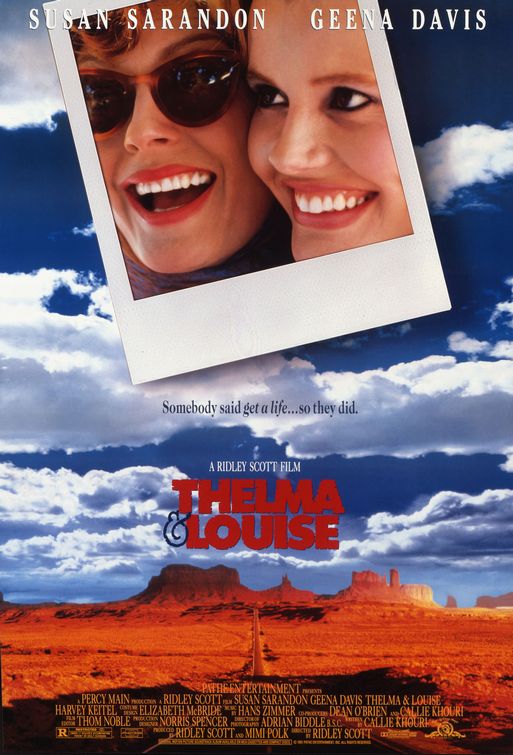
BLOCKBUSTER HISTORY: ON THE ROAD WITH SUSAN SARANDON

Every week this summer, we'll be taking an historical tour of the Hollywood blockbuster by examining an older film that is in some way a spiritual precursor to one of the weekend's wide releases. This week: Tammy is about being desperate, broke, screwed over by a man, and looking to solve it all by taking to the road with Susan Sarandon as your wingman. Or perhaps it's about being comically fat and comically vulgar. But let us pretend it's the former.

Almost a quarter of a century on, I'm pretty close to certain that the final scene is the most famous thing about Thelma & Louise, so I'm not going to hesitate in talking about it. Bail out if you need to - if there's any way to see the film without knowing where it ends up (I missed my chance by a solid 10 years), you should do it, because it's one of the great American films of the '90s, and the best thing that Ridley Scott ever directed that didn't take place in an impressively designed industrial future.

The reason I lead with the ending, of all things, is because it's the ending, however iconic and perfect, that tends to problematise what the film actually turns out to be, relative to what it's acting like it has been the whole time. Basically, we have a film that looks like empowerment, in which a pair of women who've gotten all fed up with the bullshit of men stop putting up with it, and reclaim their lives. And, having spent an entire film doing that, they die. Now, obviously, there's the defense that they have taken ownership of the most important thing of all - their life and death, which is now not being conceded to the male law enforcement officers surrounding them at the edge of a canyon. But it's a hard thing to describe as "feminist" a movie that only allows its female leads to experience self-empowerment if they pay with their lives at the end of it.

None of which, I want to make absolutely clear, is to say that Thelma & Louise is terribly bad. It's not even to say that it's not still, mostly, a bold and angry statement of feminism; and we could also argue that the film is striking a blow for equality precisely in that it's willing to present its pair of heroines the way that so many male characters have been in so many movies: as likable, relatable characters that we all root for, even as they're doing terrible things and making exaggeratedly bad life choices. It is, after all, an "outlaws on the run" thriller, and those are easy to adore for the complexity of the characters, not for how admirable they are. All that screenwriter Callie Khouri (whose post T&L career - that is to say, the lack thereof - is bizarre and frustrating) did was to apply that framework to a pair of women going through specific experiences that a man wouldn't, and let the characters be who they had to be, even when that means that they're wrong. So maybe it really is feminist. I don't know. As I have a penis, I long ago determined it was best if I prohibit myself from having definitive opinions on these matters.

Anyway, artistic representation and politics are fun to discuss and all, but it's no good to get so stuck in the mud as to lose sight of the fact that Thelma & Louise is an absolutely terrific movie, buoyed up by a pair of tremendous performances from Geena Davis (as Thelma) and Susan Sarandon (as Louise), both of them doing what might easily be declared to be the best work of their careers. Scott's directing is jaw-droppingly good considering how far the material is from what any glance at his films before or since would indicate to be his comfort zone; it has the first truly great score composed by Hans Zimmer; and it's the last film Adrian Biddle shot before his career plummeted into making generic boilerplate crap like 101 Dalmatians, 102 Dalmatians, and the deathless City Slickers II: The Legend of Curly's Gold look at least halfway decent, and the best thing the cinematographer ever did. Any fool who can at least use the focus ring correctly can make the Southwest of the United States look like the most gorgeous landscape created by God in a particularly dramatic mood; but there is true greatness in making the California and Utah landscapes where Thelma & Louise was shot (though no scene in the travelogue takes place in either of those states) look the way Biddle did. The film relies, to a degree that isn't given sufficient credit, on its use of two color families to define the conflict and drive the narrative, and Biddle succeeds here in reducing the landscape to piercing, pungent expressions of just those colors: the hard orange of the earth, the creamy blue of the sky.

What I had never realised before was that Thelma & Louise is, in fact, an early example of the old "orange and teal" trick that would, 15 years or more after its release, come to ruin visual expression in mainstream cinema; perhaps because it had to be done knowingly and purposefully and above all, in advance, with no relying on digital tinkering in post to boost all the colors to a point that Vincente Minnelli wouldn't have been able to imagine in his nightmares, Thelma & Louise also has a more useful and effective presentation of those colors. Basically, blue and orange don't dominate the film simply because they contrast nicely with each other (though God knows they do), but because of what that contrast connotes. Basically, Biddle and Scott use color-coding to divide the film into "teams", or rather to use the colors to explain what team is "winning". Blue and related colors are, in this film, exceptionally sleek and exceptionally cold, and it is always used to define spaces dominated by men. Orange, yellow, brown, and all sorts of earth tones, are warm, associated with light sources, and come to the fore in moments when Thelma and Louise are free to be themselves. The first we see of Louise, in the opening shot of the main movie after the picturesque landscape photography beneath the credits (given hazy, half-menacing, half-dreamy emphasis by Zimmer's zoned-out main theme; apparently, Scott only included an opening credit sequence after hearing Zimmer's music and deciding it needed a special moment to be foregrounded), is as part of an undifferentiated mass of human activity in a diner where she waits tables under a manager with a deeply unimaginative sense of leering and flirting; and this space is bright and very cool and blue. Thelma is introduced moments later, in a hushed and quiet home she shares with her bullying husband Darryl (Christopher McDonald); it is dim and so harsh in its metallic blues as to feel like a robot's innards. When the women leave on their road trip, it's in Louise's shiny green car, the one object that obviously sits outside of the film's duochromatic scheme, and which is situated in the frame in a way that emphasises its sleekness and potential energy, pointing off at the dusty, bright ground where the adventurers are about to escape the chilling blue that dominates and defines their everyday life. And so it is throughout: every time the women are being in some way trapped by men - rapists, hunky thieves, Louise's boyfriend, cops - blues start to creep in and dominate, as the film loses visual warmth by the frame.

It's absolutely gorgeous filmmaking, and would be even if Khouri's script wasn't so smartly balanced - it's a road trip movie in which every scene feels like it's building on the one before, rather than simply stringing along incidents in a more-or-less dramatic arc, which is impressive even without bringing the sharp characteristations into it - or Scott's direction so focused and tense. At 129 minutes, Thelma & Louise is awfully long for a story that could have been told in a '70s exploitation picture (which, in a lot of ways, it resembles) in two-thirds the running time, and it keeps ditching to scenes of the primary investigator Hal Slocumb (Harvey Keitel) hunting the women while sympathising with them, among other, even more disposable moments; yet it flies by and never feels like there's even a single moment wasted. The amount of visual variety helps with that (the contrast between snug close-ups and extremely wide panoramas filling up the anamorphic widescreen frame is marvelous), and so do the tremendous lead performances; Davis at her best isn't up to pulling attention from Sarandon, but the latter actress is absolutely not selfish, and the interplay between the two actors is fresh and relaxed and joyful, while their individual highlights showcase all sorts of marvelous character detail - Sarandon's exquisite body acting during a phone call with her boyfriend (Michael Madsen), all twisted up and nervous and clenched; Davis's schoolgirlish slavering over the hunky hitchhiker played by fresh new discovery Brad Pitt (whom the camera happily ogles, an impressive feat given all the straight men making the film). And it has some absolutely flawless line deliveries: Davis's blunt, authoritative "How long before we're in goddamn Mexico", with a look of perfect clarity and strength on her face, or Sarandon's "The scene of our last goddamn crime!" spoken with an enthusiasm and humor that come from nowhere and is positively electrifying.

The thing's not perfect: in his 1991 review, Roger Ebert adroitly noticed that the final freeze frame fades to white with "unseemly haste", and it certainly does feel like the movie suddenly jams to a halt, like a roller coaster that flings you against the safety bar when you pull into the unloading station, and it takes a lot of wind out of the whole feature. But it's freakishly close to perfection, full of tremendously smart images cut together by Thom Noble with a lot of tumbling momentum and a hint of irony (the cutting seems to be as eager to get away from Darryl as Thelma is), a whole host of outstanding supporting performances from basically everybody, and Sarandon and Davis lording over everything with two of the best roles mainstream Hollywood gave to any actresses during the whole of the 1990s. It's a smart deconstruction of social norms and an exciting, fun, tight thriller, and neither of those successes ever gets in the way of the other; basically, this is the kind of film that one wishes every mainstream movie would aspire to be, and it succeeds in almost every way at fulfilling those aspirations.

Chủ Nhật, 6 tháng 7, 2014

HOLLYWOOD CENTURY, 1955: In which America's greatest era of bourgeois conformity is critiqued from within; and also, In which we weep, like, buckets and buckets of tears

Years of intense critical re-evaluation, from Marxist theorists, feminist theorists, queer theorists, and structuralists, have brought the career of German emigrant Douglas Sirk to a level of respectability and significance that he was not generally accorded in the 1950s, when he was regarded as one of several nobodies churning out "women's pictures", and producing what is now regarded as his most important work. And while those theorists and scholars deserve all our thanks for bringing to light one of the great visual stylists working in America between the end of the Second World War and the 1970s, I think we must be leery losing sight of the fact that, class commentary this and gay coding that aside, Sirk made really fucking good melodramas.

Take, if you will, his 1955 All That Heaven Allows, the film upon which perhaps most of the theory raising him to the level of auteur based itself; I think we can fairly securely call it his signature film (his "best" is another matter, and we don't need to jump down that rabbit hole). It is nonsense, undoubtedly: the director himself acknowledged that Peg Fenwick's script, from a story by Edna L. Lee and Harry Lee, was "impossible", and he had to fix and re-shape it over the course of shooting the movie. But however florid and hokey (that is to say: however melodramatic), there's never a moment where it feels like Sirk wasn't treating the story with absolute commitment on its own terms. The colors, the blocking, the music: all of it builds to legitimise and enrich that impossible story, not to undercut or subvert it.

The action picks up in a small town in New England during the autumn, where we meet widowed Cary Scott (Jane Wyman), mother of two grown children, the young professional Ned (William Reynolds) and the college student Kay (Gloria Talbott). She has a best friend in Sara Warren (Agnes Moorehead), who keeps her abreast of all the gossip with the country club wives who make up the closest thing Cary has to a social circle, but mostly, as far as we can tell, she spends her time in the quiet, alone. That being said, there's no obvious evidence that she has the imagination to realise that she's bored or unfulfilled, until the fateful morning when Sara has to cancel lunch and that leaves Cary with nobody to talk to but the gardener: one Ron Kirby (Rock Hudson), who has been pruning her trees for years, and who took over from his late dad, who pruned the trees before him. And it takes very little contact with Ron before Cary starts to have all kinds of funny feelings, both of a heightened, philosophically and emotionally reflective kind, and of the more grubby, sweaty kind as well. Ron, for his part, more than reciprocates, and by the time winter sets in, they're engaged. But this sets Cary against a society in which the appearance of propriety is everything, and widows are expected to wither away of respectability, or at best to only ever have romantic entanglements with miserable tedious assholes of their own social group and age bracket. And so their love is attacked and challenged, in both subtle and raging explicit ways, by very nearly every one of Cary's friends and family members. Ron's friends, meanwhile, are Thoreau-reading bohemians who couldn't give less of a shit.

What's amazing to me is not that at some point in the late '60s or '70s, scholars started to tease out how this could possibly function not just as a tearjerker but also as Sirk's caustic attack on social values of the mid-'50s; it's amazing that it might ever have been read any other way. Make Cary's neighbors space aliens instead of boring white suburbanites, and taa-daa! you have Invasion of the Body Snatchers, a parable for the fetish of conformity that marks the decade in the public consciousness. All That Heaven Allows isn't a parable; it's much too blunt and direct for that word to apply.

But still, melodrama is like sci-fi or horror in that it's privileged to say things in a direct, high-impact way, without the gentility of Respectable, Dignified Drama. It gets to be sharp-toothed and blood red, and the way that the film demonstrates how pointlessly nasty all of the Good People are being in condemning Cary for the crime of having desires and acting on them is merciless and unmissable - every time I watch the film, knowing exactly where it's going, I still get blindsided by how disgusting the Scott children turn out to be in their final appearance, and remain freshly impressed by how Sirk and his invaluable cinematographer Russell Metty foreshadow this development by showcasing Kay's guilt-tripping freakout - the moment above all else that breaks Cary's resolve and self-interest - in a kaleidoscope of gaudy colored lighting that plays like a disconcerting bad dream even in a film where bright color clashes are to be found somewhat often, and in which Kay in particular is often staged against a context of jarring gaudiness, often paired with self-important body language involving taking off her glasses, standing erect and inclining her head in a clear "I'm smarter than you are, so listen to my smartness" gesture. Boy, does Sirk ever enjoy mocking Kay.

Color is always an important signifier in this film, with every scene and damn near every shot doing something very particular and purposeful, especially in contrasting hot colors with cooling ones. In the beginning of the film, Cary is associated with reds and oranges: her clothes, the bright autumnal trees that require pruning by a rugged American man-hunk like Ron (incidentally, I'm not terribly keen on readings of the film that foreground Hudson's homosexuality, even though I do not necessarily disagree with them, for this reason: if we read gay coding into Ron, it deprives Cary of her unambiguously heterosexual blossoming. And it's her movie more than it's Ron's). The first beat of the plot, properly speaking, finds Sara showing up in a blue dress in a blinding robin's egg blue car, violating the frame-filling field of reds, the moments of greatest passion between Cary and Ron, or more properly speaking between Cary and Ron's way of life, are those in which reds, yellows, and oranges are contrasted with the whites, blues, and greys visible through windows and in backgrounds. When she gives in to peer pressure, she's reduced to wearing greys and blues, spotting reds only here and there in the frame. Worst of all is when Cary is presented, against her stated will, with a television, and we see her reflected in its cramped, boxy frame, all the color sucked out until she's just a grey and gold shadow. No sign of post-war affluence has ever looked so hideously squat and threatening and deadening as that TV.

That's dime store visual analysis, of course; any halfwit who just learned that "red = lust" in Western color symbology can watch All That Heaven Allows and come to those conclusions. But that, I'd argue, is exactly what makes the movie great melodrama: it works on such a basic, direct level, it's like being punched in the gut, hard, for 89 minutes. Subtleties that need to be teased out with great labor and attention are wonderful and all, but there's something to be said about something so potently obvious that it just roars over you. These are primal emotions, in melodramas: sex and desire, the awareness of one's own self as distinct from the society that tries as hard as it possibly can to erase the self, especially the self of a woman, especially the self of a middle-aged mother and widow. More than any other Sirk movie - hell, more than any other American film from the '50s that I can think of having seen - All That Heaven Allows is a drama about a woman attempting to claim ownership of her own life despite absolutely everything in her past conspiring to deny her that agency. I haven't seen every movie made between 1953 and 1961, but I'm deeply tempted to call it the most gender-progressive American movie of the Eisenhower era, even if it ends, in a scene that's already a bit leaden for other reasons, with the suggestion that Cary has to be a nurse before she can be a lover.

And like all truly great progressive drama, it succeeds at that because it's not constantly speaking about it. The most persuasive and compelling scenes in All That Heaven Allows are the ones where the story and characters are foregrounded more than social messaging, more even than the film's own second-half indulgence in painting all of the suburbanites as The Will To Conformity, rather than individuals. The most effective, persuasive sequences are the ones where Cary is simply allowed to be happy in a way she's plainly never felt before, with Wyman's face slowly and methodically opening itself into relaxed, joyful pleasure (it's really difficult to put into words just how perfect Wyman is in this role: it gives a great deal of opportunity to her, and she returns the favor by doing everything in exactly the right register of obvious without being broad, vividly emotional without being overwrought). The acting and the warmth of the cinematography showcase that, along with the cozy, beautiful design of all the scenes set in Ron's world (the art direction was by Alexander Golitzen and Eric Orbom), in contrast to the plush but uncomfortably open and non-living rooms of Cary and the country clubbers. The difference, I think, can be best summed up in a scene where Ron's friend Alida (Virginia Grey), hosting a party of all the oddballs and outsiders, gushes with unforced enthusiasm "oh, what a beautiful cake!" to one of her guests' contribution to the dinner, as the camera rushes forth to look at what is most certainly not a beautiful cake, but is probably tastier and more lovingly-made than all the fussy food eaten everywhere else in the film.

This is pleasure / that is cold - everything in the visuals and performances of All That Heaven Allows focuses on creating that one dichotomy, and then watching as the protagonist finds herself traveling between the two halves of that dichotomy for the first time, feeling alive and passionate against all the best efforts of society to prevent her. It's top-shelf cinematic sophistication in service to brute, angry sentiment about how fucked-up society and propriety are, and if it's not the bestest best melodrama that ever could be - frankly, I think at least two other Sirk films are even better - it is, nevertheless, proof that there is artistry and glory in a genre that never had to apologise for itself, not when it was this confident, beautiful, and good.

Elsewhere in American cinema in 1955
-Oklahoma! is the first of many deeply unsatisfying Rodgers & Hammerstein musical adaptations released by 20th Century Fox
-James Dean debuts, becomes a superstar, and dies, all in the span of about seven months
-Rock & roll and juvenile delinquency enter the cinematic A-list with MGM's Blackboard Jungle

Elsewhere in world cinema in 1955
-In Denmark, Carl Theodor Dreyer makes Ordet, the most shattering of films about faith and the spirit
-Satyajit Ray's Pather Panchali brings Indian cinema to the attention of the whole world
-The Polish Film School movement is ushered in by Andrzej Wajda's A Generation